

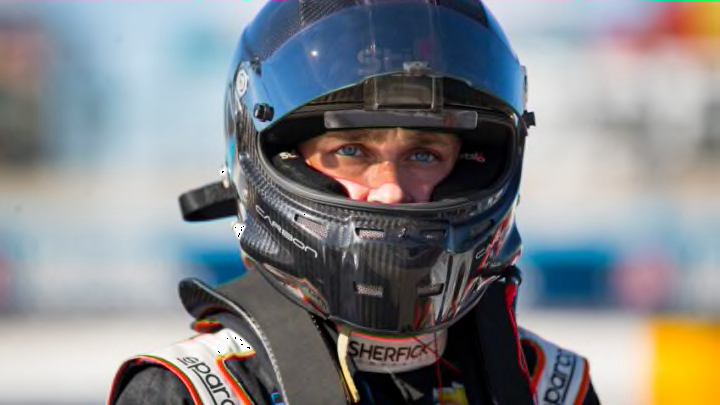
Chris Hacker, who suffered a brachial plexus injury at birth, spoke about his improbable journey to NASCAR, how he has pushed through the disability, and his partnership with Morgan & Morgan.
After competing in select races throughout the 2021 and 2022 NASCAR Truck Series seasons for a number of teams, Chris Hacker recently announced a five-race deal to drive the No. 30 Toyota for On Point Motorsports in 2023.
The 23-year-old Noblesville, Indiana native is set for his third season in the series as he continues to push through adversity caused by the brachial plexus injury he suffered a birth.
It’s an injury that affects everyday activities and very well could have hindered Hacker’s racing career, but he has found a way to push forward. The injury often occurs during birth and can result in full to partial paralysis of one or both arms. In Hacker’s case, the injury affects his left arm, causing him to rely on his right.
Chris Hacker is the first individual to have suffered from this condition and still made it to NASCAR, and he continues to strive for greater things.
Ahead of the 2023 season, Hacker is working with law firm Morgan & Morgan to raise awareness of the impact of this injury. As a part of this partnership, he is sharing his own personal story of how he has overcome the condition to strive for and achieve his goals.
“Actually about a year ago today is when I met part of the Morgan & Morgan family,” Hacker told Beyond the Flag. “Jack and Alex came out to the Daytona race weekend. Last year I was working on the cars and this year I’m racing them, so that’s pretty sick. As far the partnership and everything, Morgan & Morgan is one of the largest law firm companies that handles birth injury problems, stuff like that.
“With me having brachial plexus injury, it’s a great formation together because they’re helping kids have a better life in the future if they have these injuries and disabilities. If it weren’t for people like them, I probably wouldn’t’ be in this seat right now because I myself was able to get a settlement at birth.
“My parents were funding me for the first part of my racing career, and then at some point they finally ran out of funding. I kind of sat down with my parents and we were like, let’s throw all of this money into racing again. And so we did that, and it took me so far and we started having to get partners again once I got in NASCAR.
“Thankfully we met Morgan & Morgan and all of them, and so far they’ve just been such a great help in getting me to the track and stuff like that.”
Hacker has long supported others who suffer from brachial plexus injuries and advocated for the nonprofit organization United Brachial Plexus Network (UBPN), which hosts a camp for people with this condition and their families every two years. As a teenager, he raised enough money to send 24 kids to Camp UBPN.
“As far as the UBPN side, back when I was like 13, I started doing a fundraiser for them called 24 Kids to Camp,” he said. “My race car number back then was 24, and what we did is we raised enough money to send the kids who couldn’t afford it to this camp, which honestly is like a great opportunity.”
While brachial plexus injuries affect more children than Down syndrome and muscular dystrophy, awareness is lacking and information on the disability is challenging to find. People with these injures often suffer from severe and chronic pain and struggle to find support and adequate medical care.
“This injury is really common, but not common enough for anybody in your school to really have it,” Hacker continued. “But I went to this camp, I learned that other kids are having the same problems I do through their daily lives, such as how they apply their deodorant, or needing help tying shoes at a later age and stuff.
“For [Morgan & Morgan] to come on board and support me and kids with the same disability as me, it’s amazing. Honestly, at the end of the day, I couldn’t be more thankful for them.”
Hacker knew that getting into racing after having suffered a brachial plexus injury would be a challenge, but he credits his parents for giving him the mentality that nobody was ever going to stop him and that his injury was not going to define him.
“I don’t really work on the cars anymore; I’m more focused on the driving side,” he admitted. “But a year ago when I was working on the cars, I’d find myself struggling in the shop. If I was like laying on the ground working underneath the car and I’d hold a bolt with one hand and tighten a nut with the other, it was really a struggle to hold my left arm up in the air by itself.
“There are a lot of small things that add up quite a bit, like mentally. Small physical hindrances add up to affect you mentally. But thankfully my parents kind of gave me the mindset where nothing is going to hold me back, and they never tried to hold me back themselves. Having them as a great support system growing up has allowed me to figure out my own way of doing things, if that makes sense.”
He knows that he might not be looked at the same way as other drivers, and he even shared a story from last year’s race at Lucas Oil Indianapolis Raceway Park to back it up.
“As far as nowadays, I’m sure some of the garage looks at me differently, or thinks of me differently,” he said. “I know when I raced at Lucas Oil last year, some of the teams were calling the team owner and were like, ‘Alright, there’s no way that kid was wheeling that with what he has. … y’all are lying, there’s somebody else in it.’
“But I was still able to do it. After so many years of being behind the steering wheel I’ve kind of adapted and figured out what I need to do in certain situations to make it work for me.”
Because of how the injury affects what he can and can’t do behind the wheel, Hacker spoke about the fact that NASCAR doesn’t allow modifications to aid him in the car. While discussions have been had about changing that, he is fine doing it the same way everybody else is doing it.
“As of now, NASCAR doesn’t necessarily allow modifications,” he said. “There have been talks and stuff of certain things that could help me physically without allowing a performance advantage, and honestly at the end of the day, I don’t want an advantage, because I want everybody to know that when I make it, I made it on the same playing field that everybody else did.
“I don’t want people to think that I kind of got anything handed to me. But there have been conversations between me, my agency, and the teams and stuff.”
There are little things that the teams can adjust, however, and those things can make a big difference for Hacker.
“We are allowed to have certain adjustments to the seat on an angle, where it’s positioned, and same with the steering wheel,” he explained. “The way I personally hold the steering wheel, I keep it close to me, and then instead of like 10 and 2, I do like 11 and 5, I guess you could say, so my right hand is on the bottom of the wheel so when I go into the corners I have more range of motion, stuff like that.
“Back in the day though, when my left arm was a lot weaker than what it is right now, and when my arm would fall off the steering wheel, in case like I got spun out or something, it was really difficult to kind of get it back onto the wheel.
“My dad actually hooked up a window net from the inside door roll cage to my seat, and so when my arm did fall off, it was within an inch of the steering wheel, so it was a lot easier to kind of swing up and grab it. But no, as far as in NASCAR, everything is pretty much on a strict playing field between all the cars.”
Given the nature of the injury, Hacker’s strength is ovals, as there are strictly left turns. While he doesn’t necessarily see his right arm strength as an advantage on those tracks, he is aiming to erase any disadvantage he might have on the road courses.
“It’s hard to compare between everybody else because my injury was at birth, so that’s kind of the norm for me,” he said when asked about the use of his right arm to steer the car. “I wouldn’t really say it gives me an advantage, but driving on ovals is definitely going to be a lot easier than road courses for me I feel like. So that’s going to be something that we’re going to have to adapt to, obviously.
“I practice road courses all the time right now on sim racing, and I hate to toot my own horn, but I’m pretty good! But right now I use the paddle shifters on the sim, so I have to start practicing using the H-pattern.”
He does admit that there are inherent challenges that even come along with oval racing, just based on the nature of the injury.
“So far, the only problem we’ve run into in NASCAR really is shifting on restarts and stuff, especially if the front straightaways are curved,” he stated. “It’s hard to position the wheel correctly to ride the curve when I take my right hand off the wheel. When they’re straight, I can kind of pinch my elbow onto my rib cage and just use my own body as leverage to keep my arm straight and still to hold the wheel when I shift.
“But yeah, I wouldn’t necessarily say it gives me an advantage on the oval part, but we’re going to have to play around with the road courses here soon hopefully.”
Despite the fact that the injury isn’t all that well-known, Hacker has had the chance to speak to another athlete who suffers from the same condition, one who is also involved in motor racing.
“There is a dirt bike racer, her name is Kiana Clay, and her injury was actually caused by an accident, but she has brachial plexus injury as well,” he said. “I have had one interaction with somebody else who does professional sports, and it happened to be motorsports, so that was pretty cool to kind of make that connection between us two as far as our injuries and also the industry that we work in.”
Hacker’s 2023 schedule consists of the season opener at Daytona International Speedway this Friday night, the March race at Atlanta Motor Speedway, the June race at World Wide Technology Raceway at Gateway, the August race at Lucas Oil Indianapolis Raceway Park, and the September race at Bristol Motor Speedway.
He is most looking forward to the two superspeedway races.
“Definitely Daytona,” he said without hesitation. “Daytona is going to be actually really sick. It hasn’t fully hit me yet, but just to be able to tell myself that I’m about to be going like 200 miles per hour, the eight-year-old inside me is jumping all over while I’m still trying to play it cool as a 23-year-old. But the eight-year-old inside me is screaming right now.
“Daytona is definitely going to be a big one, and Atlanta is also fun. Atlanta is a mile-and-a-half, but we’re full throttle and there’s a lot of drafting. It’s just like a smaller Daytona. Honestly, any time I’m in the seat, whether I’m testing or racing, I’m having the time of my life. It’s a whole new world when you’re behind the wheel. Any race we’re doing this year I’m looking forward to.”
While Hacker is happy to be competing in the Truck Series, he is striving for more. He would like to land a full-time ride at some point, and his long-term goal is to be winning NASCAR Cup Series races and competing for championships. But he knows that won’t happen overnight.
“The goal obviously, as a driver myself, I want to be winning races on Sunday,” he said. “It’s going to take a lot of steps, a lot of preparation, and a lot of time to get there. I wouldn’t say I’m content with where I’m at now — I do want to be full-time competing for a championship. But I’m content with the process that it takes to get there.
“I’ve been able to understand that it’s not something that happens overnight. You’ve got to find great partners like Morgan & Morgan, who are willing to do their part and get me to the track. Now it is my job to perform and show them that I have what it takes so we can be big someday.”
The 2023 NASCAR Truck Series season opener, the NextEra Energy 250, is scheduled to take place this Friday, February 17. It is set to be broadcast live on Fox Sports 1 beginning at 7:30 p.m. ET. Begin a free trial of FuboTV now and don’t miss it!
 Add us as a preferred source on Google