

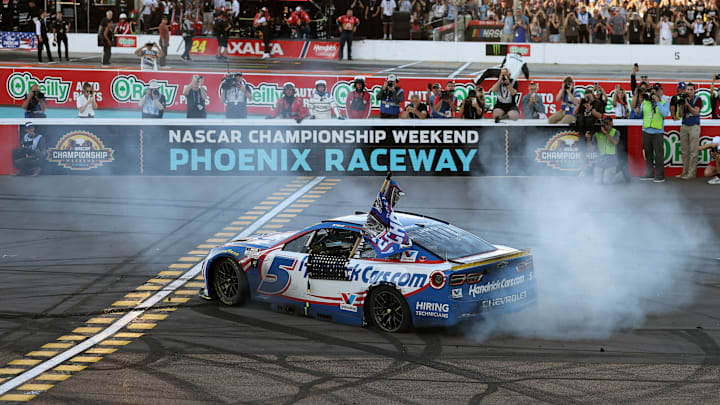
It's been over a month since the dust settled at Phoenix Raceway, but in many ways, the dust has really yet to settle following Kyle Larson's shocking NASCAR Cup Series championship over Denny Hamlin on a day Hamlin dominated, leading 208 laps compared to Larson's zero.
In many ways, it hasn't come close, particularly as it comes to NASCAR's new playoff format (if there even ends up being one).
Change has felt inevitable following year number 12 of the modern Championship 4 knockout playoff format, ironically even after a year in which the driver who scored the most points across the entire 36-race season was indeed crowned champion.
Nobody knows how NASCAR plans to crown its champions in 2026. NASCAR probably doesn't even know at this point, and though it feels like the offseason just started, time is ticking, with the Daytona 500 scheduled to get the season underway in just over two months. Sure, the rules are the same for everybody, but it helps if teams and drivers actually know what those rules are and are given time to prepare.
And now that the lawsuit is behind us, perhaps the focus can shift to where it needs to be as the 2026 season approaches.
Several changes have been floated as options to make NASCAR's championship-deciding process better, and we'll be the first to admit that there is no one-size-fits-all solution of perfection that will bring NASCAR back to its golden age. It's not happening.
And no single change, no matter how much NASCAR fans want it, is going to affect that reality.
While pairing some of these changes together may actually make sense, each individual concept would not be nearly enough to fix the issues fans have with NASCAR's championship format – even if they're exactly what NASCAR fans claim they want.
Here's a look at the five biggest changes that won't actually fix NASCAR's playoff problem.
Four-race championship
The only thing this format would do is eliminate the winner-take-all Championship 4. There would still be a Championship 4, and there would still be a knockout playoff format leading up to the Championship 4 to ensure that four drivers are competing for the title during the four-race sprint to the finish.
Even if the playoff field is reduced from 16 drivers to 12 (since there would be just two three-race rounds instead of three), getting hot at the right time would still be valued far more than most fans want it to be.
Quite frankly, it might be valued even more than that, since it would only take two well-timed wins, rather than three, for someone who had a "mid" regular season to win their way into the championship showdown.
Eliminating win-and-in
NASCAR's current points system does nothing to reward winning. It rewards consistency, rather than being consistently good, which is totally opposite of what IndyCar's system and Formula 1's system do.
Back-to-back 16th place finishes should not be worth more than a win and a DNF, because then there's no incentive to do anything other than hide out and ride around. Stage racing turns the system further on its ear, but we'll get into that a little bit later on.
Save for maybe 2022, when Ryan Blaney would have missed the playoffs with a third place finish in the regular season standings had Kurt Busch not gotten injured (and fourth-place Martin Truex Jr. did miss out), the drivers whose playoff spots are being "stolen" by upset winners are drivers who have little-to-no chance to be championship contenders anyway. Were Ryan Preece and Ty Gibbs really "deserving" of making the 2025 playoffs?
The only argument you could make here is reducing the playoff field from 16 drivers to 12, in which case this change could work. But winning should still matter more than riding around 14th every week, and right now, NASCAR's points format, in and of itself, unfortunately rewards the latter.
Chase format
The pre-2014 Chase format may not have gotten the criticism that the modern format gets (unless your name is Jimmie Johnson, and fans couldn't stand you winning five straight titles from 2006 to 2010 and literally wanted NASCAR to change things to prevent this from happening again), but the bottom line is that it still makes the 26 regular season races less meaningful.
It's still about being at your best when the lights shine brightest, rather than being good over the course of the entire season. Again, whether 12 or 16 drivers would be let into the postseason field, there would inevitably be claims of "illegitimate champion" if an underdog driver with a relatively lackluster regular season ends up coming out on top.
For what it's worth, this year's top playoff scorer (pre-Championship 4) didn't even make it into the Championship 4. But that driver wasn't the top scorer over the full 36-race season, so fans still would have been upset had he won the championship.
Rotating the championship race location
This, in and of itself, is a good idea. That's not the point. The point is that NASCAR finally opted to implement this change beginning in 2026, when Homestead-Miami Speedway is set to return as the site of the season finale for the first time since 2019, ending Phoenix Raceway's six-year run.
But simply switching up the location of this race each year doesn't change how NASCAR fans feel about the playoffs in general; it doesn't even qualify as a temporary bandage for a much deeper problem.
And given NASCAR's propensity to make decisions that fans are all but guaranteed to criticize, switching up the location might not even be the best idea, depending on which locations end up getting the coveted championship spot. Should a title really be decided at Talladega Superspeedway?
Full-season points format
And there it is, the one option that fans seem to think will solve everything that is wrong with NASCAR. But unless stage racing, which was literally introduced in 2017 as a way to enhance playoff strategy, is abandoned, a full-season points format is just as gimmicky as any playoff format; this isn't 2003 anymore.
Kyle Larson led all drivers in total points scored in 2025. But without stage points, he wasn't even in the top three.
Should running eighth instead of ninth on some random lap in an early March race really decide the championship? Should a race winner really be able to finish as low as 11th in total points scored, while the 16th place finisher leads all drivers in points?
I don't see why we're ignoring the fact that this would, at some point, absolutely and inevitably lead to an outcry that would rival any outcry from the modern Championship 4 era.
Not to mention the fact that NASCAR's points system is inherently flawed, as we touched on above.
 Add us as a preferred source on Google