

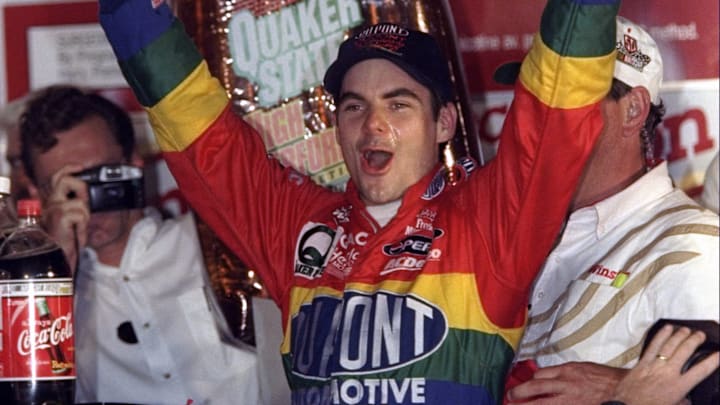
Jeff Gordon is one of NASCAR's greatest drivers of all-time. He's a four-time Cup Series champion, 93-time race winner, and at the peak of his powers, he was a worldwide sensation.
He made movie cameos. He hosted Saturday Night Live. He was a Hollywood superstar who happened to drive race cars, providing NASCAR with the perfect pretty-boy foil to the rough-and-tumble culture embodied by men's men, such as the legendary Dale Earnhardt. Their rivalry helped the sport's popularity soar to the greatest heights it has ever reached, and likely ever will.
Gordon's dominance also benefitted from perhaps the easiest situation any driver has had this side of Richard Petty. He was the ultimate product of NASCAR's "Lost Generation".
How a decade-long talent void and multiple tragedies made Jeff Gordon a legend by default
Here's a mind-boggling fun fact: only one driver who was born in the 1960s ever won a Cup Series title. That was Bobby Labonte, the 2000 series champion. Beyond him, it's a who's who of "Hall of Pretty Good" candidates. Jeff Burton and Greg Biffle are likely the next-best two, and the latter wasn't even competing at the top level until 2003.
There is the asterisk of Davey Allison, who was on track to be an all-time great, the face of his generation. But his untimely death in 1993 tragically ended that trajectory, and the driver who replaced him, Ernie Irvan, suffered a near-fatal injury the following year.
This effectively eliminated two drivers who still had many high-level seasons ahead of them from the ranks of the Cup Series elites.
All the while, Earnhardt and his peers were beginning to cross over to the wrong side of 40. The best days of Rusty Wallace, Bill Elliott, and especially Darrell Waltrip were all behind them, and no one was stepping up in their place. No one, except for the 21-year-old prodigy driving the bright rainbow DuPont Chevrolet.
It was unheard of in the early 1990s for top Cup Series teams to hire drivers as young as Gordon, but he was a special prospect. It only took three years for Rick Hendrick's gamble to pay off with a Cup Series title, and as his competition got older and older, his job got easier and easier. After the old guard aged out, his primary rivals became Mark Martin and Dale Jarrett, who themselves were no spring chickens.
The rest of Gordon's own generation didn't start arriving in Cup until Tony Stewart made the transition from IndyCar in 1999. In the time beforehand, Gordon absolutely feasted on some of the shallowest fields of NASCAR's modern era, racking up 42 wins and three titles by the end of 1998. At age 26, he was on pace to shatter every record in the book.
But the pack caught up. He and Stewart, who were born in the same year, won a nearly identical number of races (51 to 49 edge to Gordon) from the time they started competing against each other in 1999.
Then, the true market-correction of the Gordon Era came when Jimmie Johnson dwarfed him while they were both members of the same organization for 14 years.
Jeff Gordon's Era vs. Jimmie Johnson's Era summarized in one mind-blowing statistic. Career wins by drivers who were rookies within 5 years of their rookie year (before or after), not including themselves. pic.twitter.com/n1vClPJwab
— Ryan McCafferty (@rjmanalytics) December 4, 2025
Gordon is still "one of" the greatest drivers in NASCAR history. But "the" greatest would be a stretch, given the context behind his reign of dominance – the most iconic, perhaps, with only Earnhardt rivaling the household name appeal he brought to the sport. His image was that of Superman on wheels. It was also an image built by the perfect storm of having an entire generation virtually all to himself.
 Add us as a preferred source on Google