

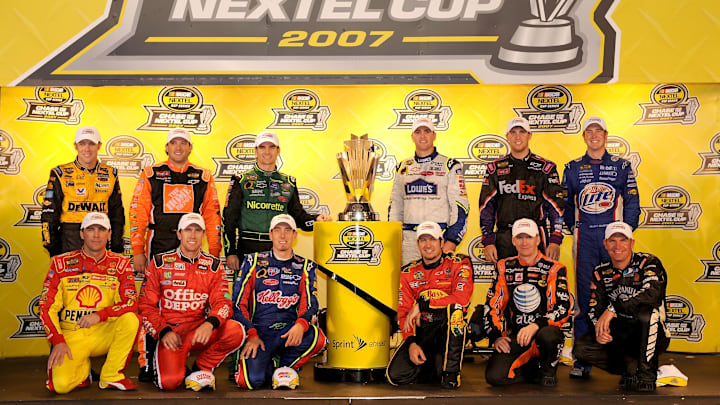
On the final lap of the 2001 Daytona 500, the NASCAR Cup Series world changed forever. Dale Earnhardt's No. 3 Chevrolet made contact with Sterling Marlin, lost control, and slammed into the outside wall, killing him on impact. The sport lost a seven-time champion, arguably its greatest driver of all-time.
Even more than that, NASCAR lost its identity. Earnhardt was the human embodiment of American stock car racing. He represented a culture of blue-collar hypermasculine toughness, and he brought the Cup Series into the mainstream world. To this day, there are people who claim that "NASCAR died when Dale died."
It's unfortunate, because from a competition standpoint, the years immediately following his death were the greatest era in Cup Series history.
The 2000s were NASCAR's golden age, yet no one will ever admit it
While everyone was coping with Earnhardt's death, the Cup Series saw a trend that has never been remotely replicated at any point before or since. In eight of nine years between 1999 and 2007, at least one rookie driver found Victory Lane. The only exception was 2004, when Kasey Kahne should have won multiple times had it not been for comically bad luck.
By the middle of the 2000s, NASCAR had its deepest fields of all-time. This was both a product of the strength of its drivers as well as its teams, with a booming economy that allowed for all 43 cars on the grid to be fully funded and capable of running competitively. Again, this is something that could not be said of any other era.
NASCAR's popularity actually continued to increase in the years immediately following Earnhardt's death, peaking in 2005. This could be explained as somewhat of a delayed reaction, with the impact of the sport's changing landscape not yet fully setting in until later in the decade. But by the end of the 2000s, the Cup Series had a full-blown identity crisis on its hands.
Changes to the sport, such as the Chase for the Cup and the of the Car of Tomorrow, contributed to turning fans away. But more than anything, it was the way the drivers were perceived. They were viewed as too corporate, too vanilla. Many were deemed "rich kids" and "nepo babies". They weren't guys you'd grab some drinks and smoke cigarettes and go hunting or fishing with. They were considered lesser men.
They were, however, better at driving race cars than the beer-bellied, goofy mustache-sporting good ol' boys of the 1990s. From a logical standpoint, it's non-negotiable. There's a reason Jeff Gordon went from winning 55 races in less than 300 starts before his 30th birthday, to 38 for the remaining 14 years of his career.
Nearly every young driver of the 2000s was an immediate upgrade on the veteran they either replaced or became a teammate to. Within three years, Jimmie Johnson had taken over Hendrick Motorsports from Gordon. Ditto Tony Stewart supplanting Bobby Labonte at Joe Gibbs Racing. Kurt Busch and Matt Kenseth usurped Mark Martin and Jeff Burton as the faces of Roush Racing.
Evernham Motorsports didn't miss a beat after Kahne replaced Bill Elliott. Ryan Newman outperformed Rusty Wallace at Team Penske from the get-go. Elliott Sadler, of all people, outran Dale Jarrett as his Robert Yates Racing teammate. And Kevin Harvick, the driver who had the hardest shoes to fill of all, took three races to become a Cup Series winner in Earnhardt's old ride.
Were all of those drivers better? All-time, not necessarily, but in the moment, absolutely. The late 1990s had the weakest fields of NASCAR's modern era, a product of an entire generation that never made it.
Most Cup Series seasons have at least a dozen or so future Hall of Famers on the grid, a number that dipped as low as eight in 1996, and the majority of them were aging in a bad way. By 2002, it was up to 14, where it stayed throughout the 2000s and most of the 2010s.
A good exercise in comparing era strength: how many NASCAR HOFers competed (min. top 25 in points) in each modern era season. Including this year’s class and future locks (any champs plus Hamlin).
— Ryan McCafferty (@rjmanalytics) October 9, 2025
Ended with 2017 because after that there's too much grey area with active drivers. pic.twitter.com/UP8zxrUm0J
The 2000s were NASCAR's "Greatest Generation", yet sadly, they're remembered as the years that killed the sport. The nostalgia goggles for the 1990s exist for the same reason as the nostalgia goggles for Kobe Bryant's NBA era, because it was considered the last age before the world got soft.
Maybe it was. Maybe the drivers weren't as tough anymore. Maybe they weren't as interesting or as relatable to the common man – the decline in ratings reflects that. But they were better.
 Add us as a preferred source on Google