

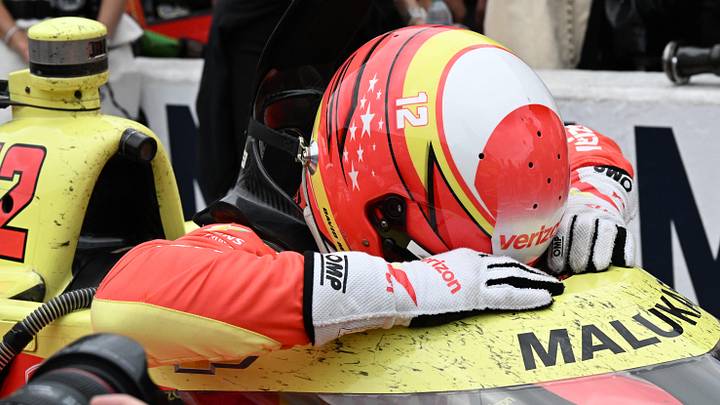
There may be 32 losers in the Indy 500's field of 33, but only one of those losers has to deal with the pain of finishing second.
And only one loser in the history of the Indy 500 has had to deal with that level of pain in a second place finish, even if he did become the third driver in the history of the race to lose the lead on the front straightaway of the four-turn, 2.5-mile (4.023-kilometer) Indianapolis Motor Speedway with the checkered flag in sight.
Team Penske's David Malukas took the lead from Meyer Shank Racing's Marcus Armstrong on the restart with just one lap remaining, but Meyer Shank Racing's Felix Rosenqvist was able to maneuver his way from third to first, and all impressively on the outside, on lap 200 of 200.
He took the lead from Malukas with just a few feet to go before the yard of bricks, and his 0.0233-second margin of victory in the race's second one-lap shootout since 2023 is the smallest in the race's 110-year history.
Additionally, the lead change was the 70th, extending the race record. The previous record was 68 in 2013. No IndyCar race of any kind had seen that many lead changes since Fontana produced 80 in 2015.
But Malukas wasn't the only big loser of Sunday's running of the "Greatest Spectacle in Racing", even though it is he who will be remembered for the ultimate "almost", and for his visibly emotional reaction after watching what looked, at least through turn three, very much like his win slip away.
And if you don't know what Indy means, compare his reaction to the reaction of the Canadian Grand Prix (yeah, we sort of forgot that race was happening, too) runner-up. Absolutely nothing compares to the Indy 500.
Without further ado, here are five of the other biggest losers from the Indy 500.
Alexander Rossi
It was an incredible month for Alexander Rossi, until things went south in Monday practice, when a massive crash resulted in injuries which required surgery and forced Ed Carpenter Racing to move to a backup car.
Rossi had qualified a career-high second, and he even gave the broadcast a heart symbol with his hands on the steering wheel during practice in the build-up to qualifying.
Things were promising early, as he swapped the lead with polesitter Alex Palou early on. But he faded after a slow pit stop, and he wasn't heard from again throughout the rest of the afternoon. A mechanical issue ultimately ended his race for the second consecutive season.
It was a disastrous race for Ed Carpenter Racing as a whole, as Ed Carpenter crashed out early and Christian Rasmussen was also forced to retire with a mechanical issue. He wasn't a factor all race like many had expected him to be.
Zak Brown
The past two Indy 500s have produced 1-2 finishes from ex-McLaren drivers. In this case, it was two drivers with whom the McLaren CEO had previously cut ties, when he had more than one opportunity to keep both.
Zak Brown was prepared to cut ties with Rosenqvist after 2022 but was effectively forced into keeping him when Alex Palou was retained by Chip Ganassi Racing. He replaced him with Malukas after 2023, but Malukas was dropped by the team before ever running a race due to an offseason injury. The irony of it all is he didn't find a full-time replacement (Nolan Siegel) until Malukas had returned with another team.
Well played, Zak. At least he had the F1 race to look forward to. Oh, wait...
Meanwhile, Pato O'Ward, who was ahead of Rosenqvist as the leader on their particular pit strategy until the middle of the race's final stint, continues to answer the "is it finally his year?" question with "no". At this point, it almost seems like he's used to it, although fourth is less heartbreaking than second here. It's his fifth top four finish since 2021.
He always seems to be in the mix, yet his car never seems to be the fastest car, and he has yet to finish the deal. He's been in the "best to never" discussion for years now. Again, McLaren is the Buffalo Bills of IndyCar: annual preseason darlings and offseason champs.
AccuWeather
"Rain will postpone or delay the race" were the exact words on AccuWeather's forecast for Speedway, Indiana on Sunday.
As James Hinchcliffe once famously said, that's adorable.
The race was red flagged for what was basically two seconds of light mist at one point, and there was another brief yellow for moisture a little bit later on. But it didn't actually rain rain until after the checkered flag had flown.
It was never delayed, and it was never postponed. But it will be one or the other. It will. We know. Trust us. It will. We promise. It will. Pack the ponchos. Better yet, don't even come; it's going to be a rainout. See you on Monday.
AccuWeather, or inAccuWeather?
Hey, at least it was wrong in what turned out to be a favorable direction for the fans.
Better strategy: show up and pray. It may not work 100% of the time in your favor, but it beats relying on the roulette wheel that is online weather forecasting.
The leader
There are always mixed reactions when it comes to the effect of the draft, but with this year's Indy 500 producing the most lead changes ever and the closest finish ever, the consensus is justifiably that the race itself was indeed an all-time classic.
When Rossi and Palou were exchanging the lead early on, it was viewed as a game of back-and-forth to save fuel. Fair enough. Same deal with Palou and Chip Ganassi Racing teammate Scott Dixon, who were literally swapping back and forth once or even twice per lap for an extended period of time. Again, fair enough, and because of that, not much mind was paid to the fact that some of the passes were happening before the stripe.
But the late restarts proved that the leader truly was a sitting duck, but not to the point where that sitting duck didn't have just as much opportunity to respond, even as early as later in the same lap.
Let's not forget that it wasn't even Malukas who was the leader before field took the green flag with one lap to go; it was Marcus Armstrong, and he finished fifth, although he was still second, side by side with Rosenqvist, coming out of turn four behind Malukas. Up until Rosenqvist's huge run at the exit of turn four, Armstrong very well could have retaken the lead from Malukas in Rosenqvist-like fashion.
Unlike a year ago, it wasn't just the first and second cars in line making the moves; just look at the three-wide photo finish for third, which has gotten barely any attention.
But the leader was still at an inherent disadvantage due to the massive holes these cars punch in the air, and that produced one of the most chaotic closing sequences this race has ever seen.
Because Rosenqvist indeed got him by the stripe.
Andretti Global
For a team that looked so good in the open test and in practice leading up to qualifying, Andretti Global had nothing to show for it on race day.
Marcus Ericsson and Kyle Kirkwood worked their way into the top 10 during the race's second half, but neither one was able to stay there. Will Power was forced to retire with a mechanical issue, extending the 2018 winner's streak of Indy 500 finishes outside of the top 10 to seven consecutive years.
They haven't won the race since they won three times in four years from 2014 to 2017. At least when Meyer Shank Racing won it in 2021, Andretti Global had a technical alliance with them. This time around, it's Chip Ganassi Racing which possesses that alliance.
Colton Herta really didn't miss too much.
The 111th running of the Indy 500 is scheduled to take place on Sunday, May 30, 2027.
 Add us as a preferred source on Google