

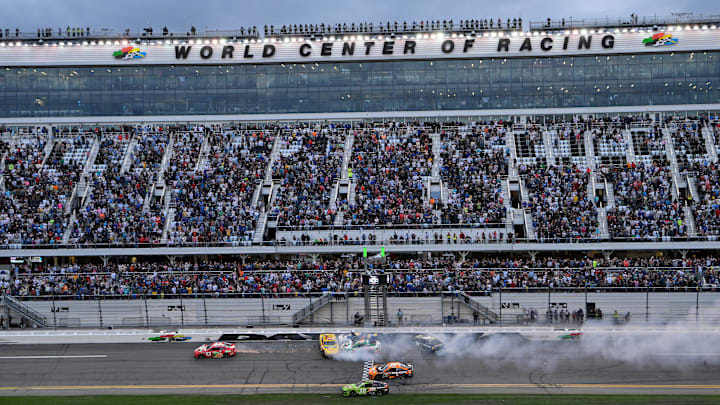
Even with the return of the Chase format and an effort from NASCAR to reward more season-long consistency, Sunday's Daytona 500 devolved into carnage once again, as Tyler Reddick survived multiple last-lap crashes to win the "Great American Race" for the first time.
The fact that NASCAR did not throw the caution flag and allowed drivers to race back to the line did not follow the precedent that has been set in the past, but the decision is certainly one that fans are not complaining about.
Reddick, who also scored the first Daytona 500 win for 23XI Racing co-owners Michael Jordan and Denny Hamlin, only led the final lap, but he totally earned and deserved the win. With that said, the events that transpired up to that point, and even on the final lap, showed what is exciting but also a problem that remains with the current superspeedway package.
NASCAR's superspeedway package put to the test again
A last lap that featured multiple leaders and a green flag finish is exactly how you want the most prestigious race in the sport to end, but it was not without its faults, either.
According to NASCAR Insights, the race featured a Daytona 500-record 25 different leaders, the second-most lead changes all-time (65), the fewest cautions since 2005 (five), and the 15th last-lap pass in the race's history.
However, 37 of the 41 cars were still involved in an accident, further highlighting the attrition that continues to exist in drafting-style races and why it has become more of a battle of surviving instead of winning the races straight up.
A few notes on the 2026 Daytona 500
— NASCAR Insights (@NASCARInsights) February 16, 2026
- 25 leaders (new record)
- 65 lead changes (2nd most all-time)
- 5 cautions (tied for fewest since 2005)
- 37 of 41 cars involved in an accident
- 15th last lap pass in the Daytona 500 pic.twitter.com/9USk4FGbtU
Another issue that played out, and one that contributed to the lead changes, was the fuel saving that particularly dominated the final stage. As the race restarted with 65 laps to go, the Toyota drivers up front traded spots back and forth as they went about half throttle and tried to save enough fuel to get to their final pit window.
Fuel-saving and attrition are two things that have become more prevalent with the Next Gen car (since 2022). Even in 2025, when William Byron repeated as Daytona 500 champion, a last-lap crash on the backstretch eliminated everyone in front of him and he managed to get through for the win.
While Sunday's race only had five total cautions, it was much of the same, as the race came down to who could survive the carnage. That does not take away from Reddick at all, but his path to victory was one similar to that of other recent Daytona 500 winners, one that involved surviving the attrition and being there at the end.
Major crashes and attrition at drafting-style tracks are nothing new, but the typical way the races have played out in recent years was once again on display in Sunday's race. It was not without a thrilling last lap and a more than deserving winner in Reddick, but the same issues were prevalent once again on the sport's biggest stage.
 Add us as a preferred source on Google