

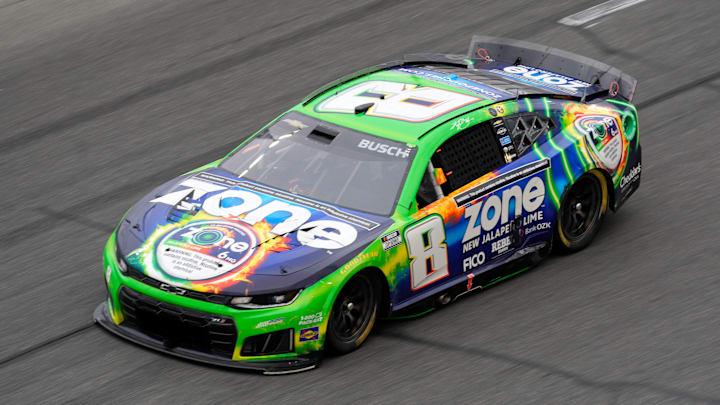
After the final restart of Sunday's 68th annual Daytona 500 at Daytona International Speedway, Richard Childress Racing's Kyle Busch fell to quickly from his position close to the top 10 to outside of the top 20 entirely.
From there, he intentionally slowed down and fell all the way back to 29th, citing the fact that he knew he wasn't going to win and he would rather avoid the possibility of his No. 8 Chevrolet being involved in a wreck.
“What the f--- am I going to rush into the wreck for? We’re running f------- 30th," Busch said.
#NASCAR… Coming to two laps to go, Kyle Busch, running just outside the top-20, lets off the gas and drops out of the lead draft.
— Joseph Srigley (@joe_srigley) February 16, 2026
“What the fuck am I going to rush into the wreck for,” Busch says. “We’re running fucking 30th.”
Busch finished 15th.
pic.twitter.com/VcSLBwdQE4
Kyle Busch's safe play pays off
Knowing how NASCAR Cup Series superspeedway races, especially this one, generally end, Busch played his cards right and gained 14 positions simply by riding around passing cars that had been involved in the inevitable wrecks that followed.
And most importantly, even from the point when he decided to drop back and gave up a handful of spots simply by intentionally slowing down, that decision actually proved to be a net gain.
Of course, Busch was criticized for the move, with some questioning why sponsors want to be associated with a driver who isn't willing to go all out for a win.
Others speculated that he could have avoided the wrecks anyway and collected a better finish than 15th, while others noted that this might well be why Busch, now 0-for-21 in the "Great American Race", has never won it, with some even suggesting it's probably why he never will.
And naturally, there were those in the ever predictable "Dale Earnhardt would never!" crowd.
All things considered, the move did exactly what Busch wanted it to do, and possibly even more. It kept him out of the wrecks, and in turn, it gained him a significant chunk of points.
It's a direct product of NASCAR's new championship format, following the 12-year run of the "win and in" knockout style format that had been one of the single most criticized elements of the sport in the modern era.
Busch, who won his two championships under the previous format in 2015 and 2019, was one of the very few critics of NASCAR's move back to the "Chase" format that was used from 2004 to 2013. He noted that NASCAR got away from that format for a reason, which is true, specifically after Jimmie Johnson won five titles in a row from 2006 to 2010 and then added another in 2013.
With the emphasis now on points and points alone, and the top 16 drivers in the regular season standings set to be the 16 playoff drivers no matter who has won the most (or any) races, Busch decided to race for points and points alone. And it worked.
Isn't this exactly what NASCAR fans have wanted for the past decade-plus?
We said in December, when there was uncertainty over what NASCAR's new postseason format might look like, that there were still going to be complaints either way, even for as well-received as the announcement of the Chase's return was. No format was ever going to be perfect.
We didn't expect those complaints to come to fruition after only a single race due to the actions of a single driver.
Here's the problem with the criticism of what Busch did. Yes, NASCAR did incentivize winning, despite the elimination of "win and in", by increasing the value of wins to 55 points instead of 40 points.
But no other point values changed, and this was always sure to rear its ugly head.
There's zero incentive to risk it all to run second or fifth or eighth. Aside from the win, every single position is only worth one single extra point, and when that second or fifth or eighth could easily become 25th or worse in the blink of an eye, as it did for several drivers who took the opposite of Busch's approach on Sunday, it’s a classic case of high risk for very little reward.
The best part? Sure, it's early in the season, but Busch's decision to drop all the way down to 29th is literally the reason why he's in the provisional 16-driver playoff picture after the 26-race regular season's first race.
Imagine that.
For years, folks have been criticized for saying things like "everyone plays by the same rules" when criticism of the Championship 4 format came up, even though that is quite literally the fundamental truth.
Now a driver goes and proves it by working it to his benefit in the first race under the new format, and we’re supposed to believe that “The Intimidator” would be ashamed.
Give me a break.
Points racing is exactly what fans supposedly wanted. Now that it’s back, it’s suddenly an issue because a driver wants to avoid a 30th place DNF – and gains several points in the process.
Race number two on the 2026 NASCAR Cup Series schedule is also a superspeedway race, that being Sunday's Autotrader 400. Will someone else try Kyle Busch’s approach this weekend? Fox is set to provide live coverage from EchoPark Speedway (formerly Atlanta Motor Speedway) starting at 3:00 p.m. ET. Start a free trial of FuboTV and don't miss it!
 Add us as a preferred source on Google