

Under the new NASCAR Cup Series points format, race winners score 55 points, rather than 40, as a way to make up for NASCAR's decision to remove the "win and in" element of the 16-driver postseason.
With stage winners scoring 10 points each, a driver who finishes a race in second place can also score up to 55 points in a race. And if that driver runs the race's fastest lap, he can actually score 56.
In a three-stage race, meaning all races except for the four-stage Coca-Cola 600 at Charlotte Motor Speedway, the only way somebody other than the race winner can score more points than the race winner is if all of this happens, and the race winner scores zero stage points.
That's exactly what happened on Sunday.
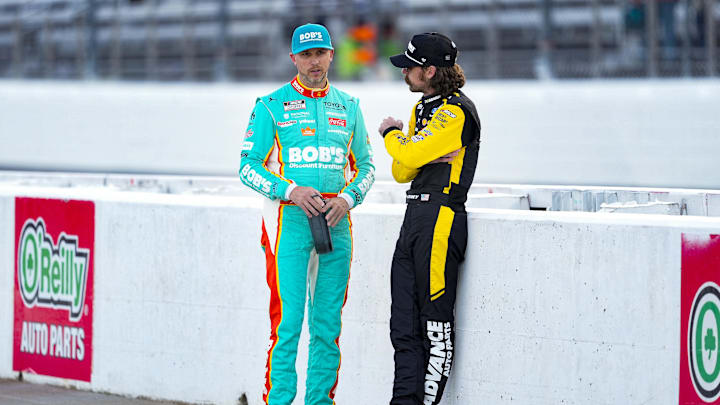
Hendrick Motorsports' Chase Elliott won the race, but Joe Gibbs Racing's Denny Hamlin scored the most points. Elliott scored no stage points, and Hamlin won both stage one and stage two and collected the bonus point for running the race's fastest lap.
This was not uncommon when wins were only worth 40 points. But under the new format, there is literally only a 0.001% chance that the winner of a three-stage race is outscored.
Let's do the math. There were 37 cars in Sunday's 400-lap Cook Out 400 around the four-turn, 0.526-mile (0.847-kilometer) Ridgeway, Virginia oval. So there is a 1-in-37 chance that the eventual second place finisher wins the first stage, and a further 1-in-37 chance that that driver wins the second stage.
We're already up to 1-in-1,369.
With 36 spots still available in stage one, there's a 27-in-36 (3-in-4) chance that the eventual race winner doesn't score any stage points (non-top 10 finish). The same is true in stage two, meaning there's a 9-in-16 shot total.
Combined, that's a 9-in-21,904 shot, good for 0.04%.
Finally, there's only a 1-in-37 chance that the second place finisher is the driver who runs the fastest lap. That brings us to a 9-in-810,448 shot, good for 0.001%.
That's 0.00111049691%, to be exact.
Note that we don't have to specify who the winner and second place finisher are here, since these odds would apply to anybody. For example, the stage one winner always has a 1-in-37 shot to sweep the stages on any given weekend, since it's a given that somebody would have already won stage one.
In other words, you don't have to divide it by 37 again to find the probability, unless you set out trying to find the odds of a specific driver pulling it off before the race begins.
Of course, the real chance was probably quite a bit higher than 0.001%, given the fact that the stage one winner inherently has more than a puncher's chance to win the second stage, and the second place finisher has a decent chance of running the race's fastest lap as well.
But not by much, since there's also probably a smaller chance than the implied 56.25% shot of the eventual winner scoring zero stage points whatsoever. So even though we're only seven races into the first year of the new format, don't be surprised if this doesn't happen again this year – or for many years, for that matter.
 Add us as a preferred source on Google