

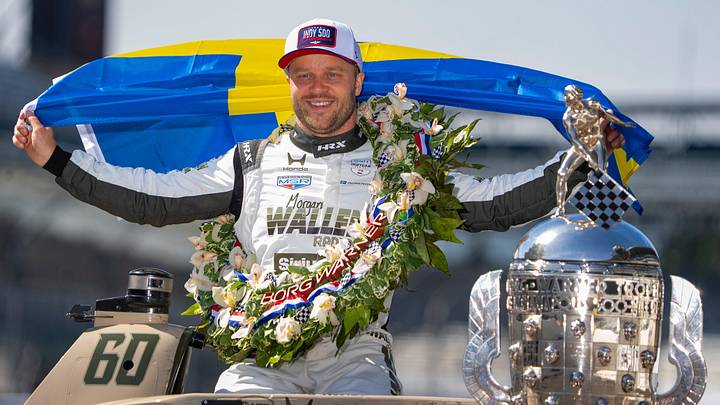
If Felix Rosenqvist had ever attempted the line he took on the last lap of the Indy 500, riding the outside of not only another car but specifically that of Meyer Shank Racing teammate Marcus Armstrong for well over half of the four-turn, 2.5-mile (4.023-kilometer) Indianapolis Motor Speedway oval, there would have been some serious discussions within the paddock.
But when it came to lap 200 of 200, it was all or nothing.
"I’ve tried all the corners except turn four on the outside at some point during the race or at least during my Indy 500 career. But in practice, you would never do that," Rosenqvist told FanSided's Beyond the Flag, during one of more than 100 interviews he did during the week following his historic victory.
"That’s the weird thing with Indy, because in practice, you just can’t take any risk because you don’t want to risk the car. It’s always a bit of a guess when you go into a move like that. But I just had no other choice, really. I was like, this is my ticket to the win, so let’s see how long it works for. And it did for sure."
It did indeed, as he became just the third driver in Indy 500 history to take the lead on the front straightaway, with the checkered flag in sight, on the final lap.
After finally getting around Armstrong in turn four, his pass on Team Penske's David Malukas, also fittingly on the outside, was the 70th lead change of the afternoon, an all-time Indy 500 record, and the 0.0233-second margin of victory was the smallest in race history.
Rosenqvist found himself in the catbird seat to win the race late, and by a much wider margin that that; he had been about 15 seconds ahead of Malukas in the closing stages, with the only cars in between being the few others that had also taken the opportunity to make their final pit stops under yellow on lap 130, while the leaders stayed out.
Rosenqvist was surprised more drivers didn't take advantage of that yellow, which allowed him to pit just one more time that afternoon with 34 laps remaining.
"We were surprised, because we in our boat, we were like, that’s actually not an alternate strategy; that’s actually the strategy, because we had an unbelievable car," he said. "Meyer Shank Racing and Honda just gave me an absolute weapon, and if you have a good car at Indy, you’re able to sit close to the car in front of you. Even when you’re a few cars back in the pack, you can just save so much fuel."
Even without the two late yellows, Rosenqvist would have been fine on fuel.
In fact, even Arrow McLaren's Pato O'Ward, who had been ahead of Rosenqvist in the early stages of that final stint, made it home fourth after pitting with 37 laps remaining in a Chevrolet.
"There’s almost no limit to how much you can save; it's exponential," Rosenqvist continued. "If you can be really, really close [to the car in front], you’re like half-throttle for the whole lap, and we just did that for the whole race. There were a lot of times where we just didn’t want to go in the lead. Actually, we wanted to sit in third."
He ultimately gave up a top five running spot to run just outside the top 10 with that pivotal pit stop, but only temporarily. There's a saying in racing that if you follow the leader, you follow the leader. The problem with that strategy is that you'll never be the leader, much less at lap 200.
That was probably what surprised Rosenqvist most about why so many of the other frontrunners stayed out when they did.
"If you kind of look back through the race, we were almost always sitting in third, except for the few times we kind of went back to seventh or eighth in a on a pit stop or restart or something like that," he said. "That was our whole idea, and we realized quickly that that strategy was probably going to work out pretty easily. We were going to gain back some track position doing it as well."
Felix Rosenqvist ready to avoid annual Indy 500 hangover?
Rosenqvist is aiming to become the first driver to win the Indy 500 and then win the next race on the schedule since Juan Pablo Montoya won Indy 500 and then won the following weekend's race at the Milwaukee Mile in 2000. However, even that happened with somewhat of a caveat; the Milwaukee race was a CART race, and the Indy 500 was not on the CART schedule.
No driver has won the Indy 500 and then the IndyCar race immediately afterward since Arie Luyendyk won the 1997 Indy 500 and then the following race at Texas Motor Speedway. But even that came after a weekend off.
A lot of the "Indy 500 hangover" can be attributed to the massively busy week that comes with winning the "Greatest Spectacle in Racing", giving the winner very little time to actually prepare for the Chevrolet Detroit Grand Prix.
Rosenqvist, who finished third in the inaugural race on the downtown city streets of Detroit, Michigan back in 2023, has embraced every minute of it, but even he admits that it's not a way he'd want to get used to living.
"I think I’m down to 600 now, but I had like a thousand messages on WhatsApp and my iMessage, and that’s not counting Instagram DMs and stuff," he said. "I feel like I just get five-minute moments where I kind of have time to call someone or catch up with a couple of texts. It’s just been a whirlwind; a lot of interviews, a lot of photos, a lot of media, talk shows, podcasts and stuff.
"But it’s cool. I’m very happy to just kind of be the face of the sport right now, and there’s a certain responsibility in that. It’s cool, all this wave we got from this race, the fact that everyone loved it so much. I love to represent that and get the world to see it more. The coolest thing has probably been – I’m a pretty, I say, normal guy – but it’s the fact that the paparazzi come up to me here in New York and they want to see my winner's ring.
"It’s just unreal. I don’t think I would really want a life like that in my daily life, but now we’re here after the 500. It is such a big deal. It makes you kind of start to understand what it is that you’ve achieved when stuff like that happens."
For Rosenqvist, winning the Indy 500 sunk in pretty quickly, given the extensiveness of the post-race celebration. But he's yet to truly reflect on what it means from a big-picture perspective, just to see his name join a list of so many all-time greats who have managed to win this iconic race.
"Little by little," he said. "I still haven’t sat down and looked at every winner because I think that’s a cool thing to do. Like when I won the Macau GP in Formula 3, you would sit down and just look at all the winners and just kind of reflect on where they are today and what they’ve done."
He won the Macau Grand Prix in both 2014 and 2015.
"Things like that take time," he added. "The fact that I did the race and I was there and cheering, the crowd was cheering, I jumped out of my car and drank milk, that has settled in. But the fact that there’s this kind of legacy and historical meaning to this, I think that will take time for me to really fully understand."
From an early age, Felix Rosenqvist eyed Indy
Growing up in Sweden, IndyCar was on Rosenqvist's radar pretty early on in his life and as he climbed his way through the racing ranks, specifically because of Kenny Brack.
"Me and my dad watched it, and a lot of people, because Kenny Brack was in the series and he won the 500 in 1999 when I was eight years old, and that’s a moment I remember very well, how big of a deal it was back in Sweden," he stated. "They broadcasted it on the national news, so we were all watching it."
When Rosenqvist joined IndyCar full-time in 2019, so did fellow Swede Marcus Ericsson, the 2022 Indy 500 winner. Their presence has allowed the sport to grow again in his home country, and it's another reason why Sunday's victory was – and is – so huge.
"IndyCar had, I think especially maybe one or two generations ago, they had the racing nerds from Sweden who really knew what IndyCar is," he explained. "So when me and Marcus came back to the series in 2019, a lot of older fans from the Kenny times came back. This is definitely a huge thing back home as well."
Becoming an Indy 500 champion is a dream come true for Rosenqvist, and even from an early age, he knew he had what it took to eventually compete at a high level and make a living driving race cars.
"When I went from go-karts to single-seaters, I definitely felt a different kind of drive towards my racing," he recalled. "I was starting to work way harder. I was spending more time doing a lot of sim racing at home and I was kind of thinking about driving and doing a lot of my own little analysis to get quicker, and somehow I think when I did go-karts, I was just so young and I wasn’t really mature.
"My dad has obviously been a massive part of my career since the beginning. But when I went to single-seaters, I started to kind of know. When I got into my teens, I started doing more of the racing part on my own, dealing with the teams and engineers. I had to become an adult pretty quickly, and I think that was the moment I was like, I think I can somehow manage this into becoming a living – with the support of my family, obviously."
Now he's proven it on the grandest stage of all, and speaking of the support of his family, now he's supporting his own.
The win came less than three weeks after his wife Emille gave birth to their daughter, Stella. And for all the disappointment that Rosenqvist had endured at Indy over the years, the fact that his win came in this particular month of May, of all years, is something that has made it all worth it.
"It is more special. It’s a fairytale. That’s the other part of this that is just so hard to grasp, that if you just look at my life and the timeline for the last year or so, what has actually happened? Emille got pregnant at the end of last year. We moved into a new house in Indianapolis and really established ourselves in the U.S., which was a massive thing for us. The birth of our daughter was the craziest moment of my life."
The Indy 500 win is, of course, a nice thing to have at No. 2.
"I can sit here and talk for 10 hours about that whole [birth] experience, but I know people want to talk about racing. But it changed me, and it made me a completely different person and sort of gave me a good perspective on life, and from there on, I was like, okay, whatever happens now, probably nothing’s going to beat this – nothing.
"We’ll just kind of take everything as a bonus from here on, and then obviously that’s the year you win the Indy 500 as well. I almost feel spoiled, in a way. I don’t know how one man can receive so many good things in such a short time, and I'm truly lucky to be experiencing all this. As I say, it’s hard to take in."
Another thing Rosenqvist was proud of was the fact that this interviewer, having spent the last few laps of the race yelling and screaming from the grandstands in turn four, could barely talk loudly enough to ask any questions.
"The fact that you don’t have a voice, that’s what I love, you know?" he joked. "I love that the reason you can’t talk properly is because of me."
The 111th running of the Indy 500 is set to be shown live on Fox from Indianapolis Motor Speedway on Sunday, May 30, 2027. In the meantime, the eighth race on the 2026 NTT IndyCar Series schedule is the Chevrolet Detroit Grand Prix, which is set to be shown live on Fox from the streets of Detroit, Michigan beginning at 12:30 p.m. ET this Sunday, May 31. Start a free trial of FuboTV now and don't miss it!
 Add us as a preferred source on Google