

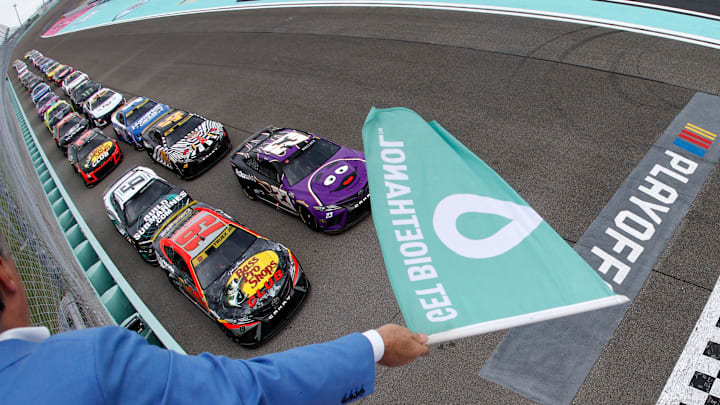
NASCAR has fundamentally changed the way they plan to crown their champions for 2026 and beyond, ending the 12-year run of the four-round, 10-race knockout playoff format and bringing back a format that closely resembles that "Chase" setup used from 2004 to 2013.
What NASCAR effectively did was turn a relatively complicated format into one that is easy to understand. Yet at the same time, they didn't really make a ton of changes.
It really just boils down to the elimination of some of the more modern "gimmicks" that NASCAR had tried to rely on to make things more entertaining.
Other than that, not much has really changed.
Here's a list of all five – and yes, there were really only five – changes.
One playoff round, not four
There are no more three-race playoff rounds and no more single-race Championship 4 title decider. The postseason is a single 10-race round featuring 16 drivers. The 16-driver total is unchanged from the Championship 4 era.
No more "win and in"
Winning does not automatically lock a driver into the playoffs anymore.
If you are in the top 16 in the standings after the 26-race regular season, you're in, whether you're winless or you've won all 26 races. If you're not in the top 16, you're locked into a 10-week battle for 17th, even if you've won five (or more) times.
No more playoff points
Stage racing only matters in terms of the points awarded to the top 10 finishers; stage wins no longer give drivers an extra point to start the playoffs. Likewise, race wins no longer give drivers an extra five points to begin the postseason.
Pre-Chase points reset values
While playoff points may no longer exist, no two drivers are set to enter the Chase with the same point total. Point totals are reset based strictly on regular season points finish, in accordance with the table below.
Standings position | Points reset |
|---|---|
1st | 2100 |
2nd | 2075 |
3rd | 2065 |
4th | 2060 |
5th | 2055 |
6th | 2050 |
7th | 2045 |
8th | 2040 |
9th | 2035 |
10th | 2030 |
11th | 2025 |
12th | 2020 |
13th | 2015 |
14th | 2010 |
15th | 2005 |
16th | 2000 |
While not confirmed, our assumption is that any ties will be broken based on regular season win totals (or further countback, if wins are not applicable), since that is how it has worked in the past.
Though this qualifies as a change, let's not forget that the top 10 drivers in regular season points were already given bonus points ahead of the playoffs, provided they actually qualified, in previous years as well. Now those bonuses have increased, and they are set to be given to the top 15 playoff drivers.
Wins have added value
NASCAR didn't change the entire points table, but wins are now worth 55 points, rather than 40. This is viewed as a compromise between getting rid of "win and in" and still incentivizing winning enough that drivers won't want to ride around mid-pack, merely staying out of trouble just to collect points.
The first season under this new format is scheduled to get underway on Sunday, February 15 with the Daytona 500, which is set to be shown live on Fox from Daytona International Speedway beginning at 2:30 p.m. ET. Start a free trial of FuboTV and don't miss it!
 Add us as a preferred source on Google