

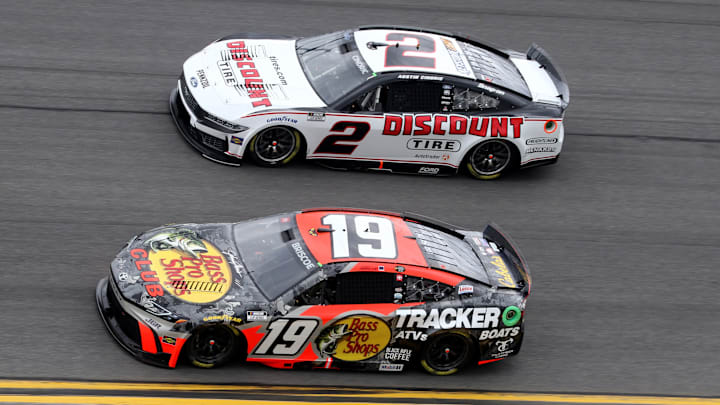
Single-car qualifying and the two America 250 Florida Duel races to determine the 41-car starting lineup for the 68th annual Daytona 500 at Daytona International Speedway are scheduled to take place in under a week, and NASCAR has changed a longtime rule as it pertains to the qualifying format.
The 36 chartered cars are still locked into the 200-lap race around the four-turn, 2.5-mile (4.023-kilometer) high-banked Daytona Beach, Florida oval, as is the No. 84 Legacy Motor Club Toyota of Jimmie Johnson, as Johnson has been granted the Open Exemption Provisional by NASCAR.
Two of the other non-chartered (open) cars are still set to lock in on qualifying speed, and two more are still set to lock in based on the results of the two 60-lap Duel races. There are expected to be eight open cars battling for the final four spots in the race.
Here's where the changes come in.
Though single-car qualifying comes first, the results of the Duel races had previously taken precedence when it came to locking into the race.
Yes, the fastest two open drivers in qualifying did lock themselves into the race, but they could still officially lock themselves in by being the top open drivers in their respective Duel race, in which case the spots on speed would go to the next fastest open drivers.
The incentive to do so was the fact that open drivers who qualified on speed were locked into the 39th and 40th place spots on the starting grid, regardless of their actual speed, while the two who qualified on Duel result had their starting positions determined directly by their Duel result (so as high as third, potentially).
This meant that the third and fourth fastest open drivers could still technically qualify on speed, should the top two drivers end up locking in on Duel result. But not the drivers fifth or lower.
The drivers fifth or lower on qualifying speed absolutely needed to be the top open finishers in their respective Duel race in order to qualify for the Daytona 500. This meant that they even needed to beat the drivers who had already locked themselves into the race via single-car qualifying.
Let's use this year's drivers as an example. Let's say JR Motorsports' Justin Allgaier and 23XI Racing's Corey Heim are the quickest drivers in qualifying. Front Row Motorsports' Chandler Smith is third, and Beard Motorsports' Anthony Alfredo is fourth.
Allgaier is in a Duel race with Smith, Garage 66's Casey Mears, and Live Fast Motorsports' B.J. McLeod, while Heim is in a Duel race with Alfredo, NY Racing Team's J.J. Yeley, and RFK Racing's Corey LaJoie.
In order for Mears to qualify for the race, he'd have to beat McLeod, Smith, and Allgaier, even with Allgaier already locked in. In order for McLeod to qualify for the race, he'd have to beat Mears, Smith, and Allgaier, even with Allgaier already locked in.
Likewise, in order for Yeley to qualify, he'd have to beat LaJoie, Alfredo, and Heim, even with Heim already locked in. And in order for LaJoie to qualify, he'd have to beat Yeley, Alfredo, and Heim, even with Heim already locked in.
That is no longer the case after NASCAR's recent rule change.
Once a driver qualifies on speed, he is no longer eligible to take an open spot based on Duel result. So if we use this same scenario, it would simply be Smith vs. Mears vs. McLeod for one open spot, and Alfredo vs. Yeley vs. LaJoie for the other.
The highest finishing driver among those groups would take the open spots, with Allgaier and Heim not factored in whatsoever since they would have already been locked in.
The incentive for Allgaier and Heim is that NASCAR now plans on awarding all starting spots (minus the front row) based on Duel results. Open drivers who lock in on speed are no longer locked into the 39th and 40th starting positions.
All things considered, it makes it a lot easier to explain. Simply trying to explain the old format, year after year, got confusing, especially since you'd have drivers battling with other drivers while totally different drivers stood to benefit (or lose).
Now the Duel races are set to provide two straight-up fights for the final two spots in the field, which is exactly how it should be.
Single-car qualifying is scheduled to take place on Wednesday, February 11, with live coverage set to be provided by Fox Sports 1 beginning at 8:00 p.m. ET. The America 250 Florida Duel races are scheduled to take place on Thursday, February 12, with live coverage set to be provided by Fox Sports 1 beginning at 7:00 p.m. ET. The Daytona 500 itself is scheduled to take place on Sunday, February 15, with live coverage set to be provided by Fox beginning at 2:00 p.m. ET. Start a free trial of FuboTV today and catch all of the action from the "World Center of Racing"!
 Add us as a preferred source on Google