

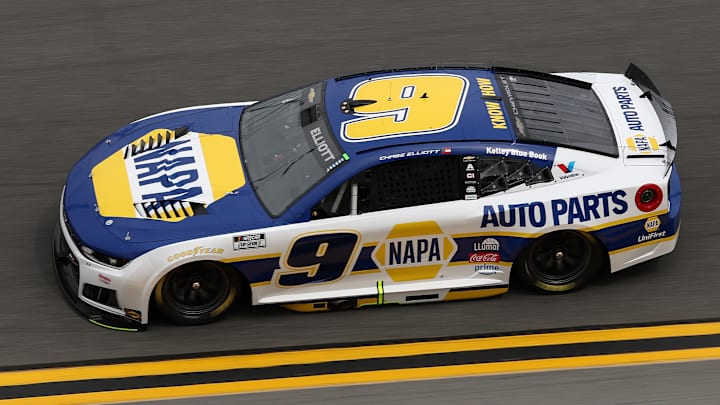
NASCAR set the qualifying order for the 2026 Cup Series season-opening Daytona 500 at Daytona International Speedway via two random draws, with the first featuring all of the cars on the entry list that were not in the top 20 in the 2025 owner standings, and the second featuring all of the cars that were.
Starting this weekend at EchoPark Speedway, formerly known as Atlanta Motor Speedway, NASCAR has returned to its usual way of determining the qualifying orders.
After using a needlessly complicated format, one which was initially implemented in 2020 to set starting lineups in the absence of qualifying that season, NASCAR changed things up before the 2025 season.
New NASCAR qualifying metric
The formula used from mid-2020 to 2024 was based on four variables: the car's rank in the owner standings (35%), the driver's finish in the most recent race (25%), the car's finish in the most recent race (25%), and the rank of the driver's fastest lap in the most recent race (15%).
Of course, the two categories weighted at 25% were effectively combined into one category weighted at 50% for drivers who were in the same cars from race to race. But NASCAR made things even more easy to understand a year ago.
The new metric consists of just two variables: the car's rank in the owner standings (30%), and the car's finish in the most recent race (70%). Fastest lap is only relevant in terms of the bonus point that was implemented ahead of the 2025 season and received a slight modification for 2026.
Drivers qualify in reverse metric order, with higher scores deemed bad and lower scores deemed good; drivers who go out toward the end of the line typical have the advantage in terms of track conditions.
Prior to 2025, the metric was used to create two evenly balanced groups, and the top five drivers from each group advanced to the second round of qualifying to battle for the pole position. There were row-by-row designations based on which group each driver was in.
Again, NASCAR made things far easier to understand in 2025.
There is just one group in the first round of qualifying, and at all tracks other than short tracks (Bristol Motor Speedway, Iowa Speedway, Martinsville Speedway, North Wilkesboro Speedway, and Richmond Raceway), each driver is set to run just a single qualifying lap.
There is no second round of qualifying except for the races at superspeedways (Daytona, Atlanta, and Talladega Superspeedway).
The only group qualifying format used following these changes is used on road and street courses, where the groups, rather than the driver-by-driver qualifying order, are determined by the metric scores.
Each group simply gets 20 minutes of track time, and the speeds are then combined to determine the full starting lineup, again with no second round of qualifying.
 Add us as a preferred source on Google