

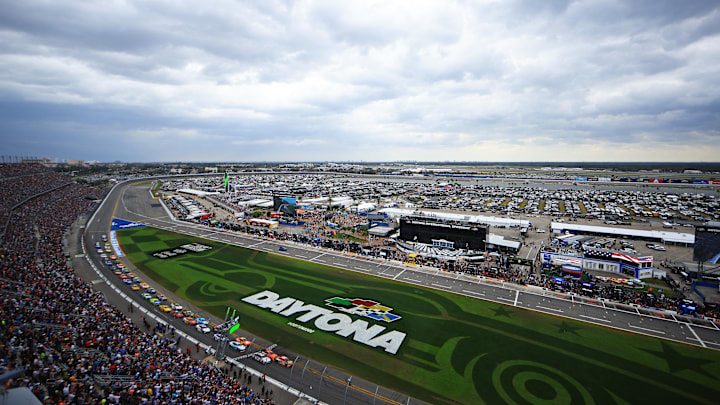
Less than a week from Daytona 500 single-car qualifying and the two America 250 Florida Duel races to set the starting lineup for the 68th running of the "Great American Race", NASCAR has made a noteworthy change to the qualifying format.
There are expected to be eight drivers in non-chartered (open) cars battling for the final four spots in the 41-car starting lineup for the 200-lap race around the four-turn, 2.5-mile (4.023-kilometer) high-banked Daytona International Speedway oval.
Jimmie Johnson is not one of them, as despite the fact that the No. 84 Legacy Motor Club Toyota is an open car, he was granted an Open Exemption Provisional, locking him into the race. With the 36 chartered cars already locked in, this announcement expanded the field from 40 cars to 41.
The Daytona 500 qualifying rules, as they pertain to the open cars, are simple.
The fastest two open drivers in qualifying are locked in. Of the remaining six, the top two finishers in each of the two 60-lap Duel races are locked in as well. Starting positions for all four open drivers who lock in are to be determined by the results of the Duel races.
Again, simple. The previous format? Not so simple.
And quite frankly, it's a format NASCAR never should have utilized to begin with.
Yes, the fastest two open drivers in qualifying were previously locked in as well. However, by locking in on speed, they could start no higher than 39th and 40th. As a result, they remained eligible to have their starting positions determined by their Duel results, in which case the next fastest open drivers in qualifying would have been the drivers to officially lock in on speed.
Let's use this year's open drivers as an example. Let's say that JR Motorsports' Justin Allgaier and 23XI Racing's Corey Heim are the fastest two open drivers in qualifying, followed by Front Row Motorsports' Chandler Smith and Beard Motorsports' Anthony Alfredo in third and fourth, respectively.
Let's say that fifth through eighth in qualifying speeds are RFK Racing's Corey LaJoie, NY Racing Team's J.J. Yeley, Garage 66's Casey Mears, and Live Fast Motorsports' B.J. McLeod, respectively.
Allgaier being the top open driver in his Duel race would lock Smith into the race on speed instead, while Heim being the top open driver in his as well would lock Alfredo in on speed.
LaJoie, Yeley, Mears, and McLeod could only possibly race their way in; they had no way of falling back on speed. Yet they would have needed to beat the drivers already locked in on speed to do it.
Let's say that the first Duel consisted of Heim, Alfredo, Yeley, and McLeod. McLeod didn't simply need to beat Alfredo and Yeley to get in, even with Heim locked already in; he needed to beat Heim as well. The same could be said for Yeley; beating Alfredo and McLeod would not have been good enough. He would have also needed to beat Heim, even with Heim already locked in.
Let's say that the second Duel consisted of Allgaier, Smith, Mears, and LaJoie. LaJoie didn't simply need to beat Smith and Mears to get in, even with Allgaier already locked in; he needed to beat Allgaier as well. The same could be said for Mears; beating Smith and LaJoie would not have been good enough. He would have also needed to beat Allgaier, even with Allgaier already locked in.
It made zero sense, and it effectively set up scenarios where the on-track battle was between Driver A and Driver B, all while Driver C stood to gain (or lose).
Now the open drivers who lock in via qualifying speed are no longer factored into the open battles in the Duel races. In the scenario discussed above, it would simply be Alfredo vs. Yeley vs. McLeod in one Duel race, and Smith vs. Mears vs. LaJoie in the other.
Again, simple.
As for the incentive for Allgaier and Heim, or whomever the fastest two open drivers in qualifying end up being, that would be achieving a starting position as high up the order as possible, as the 39th and 40th starting spots are no longer directly tied to the open drivers who lock in on speed.
In an offseason that has seen NASCAR make several favorable changes, this one certainly fits the bill.
Tune in to Fox Sports 1 at 8:00 p.m. ET on Wednesday, February 11 for single-car qualifying, and tune in again at 7:00 p.m. ET on Thursday, February 12 for the two America 250 Florida Duel races. Fox is set to provide live coverage of the Daytona 500 itself beginning at 2:00 p.m. ET on Sunday, February 15, so be sure to start a free trial of FuboTV today and don't miss it!
 Add us as a preferred source on Google