

Sunday's Jack Link's 500 at Talladega Superspeedway was salvaged in part by the entertainment of Carson Hocevar's first career NASCAR Cup Series win, but it still doesn't undo what was an absolute chore of a race to sit through.
Throughout the Next Gen era, the common criticism at NASCAR's two biggest superspeedways, Talladega and Daytona International Speedway, is that the cars lack maneuverability. They get stuck in two-by-two gridlock formation, and for that reason, spending the least amount of time fueling the car on pit road to exit first is key. As a result, significant portions of the race are spent with the field running at half-throttle in order to save fuel.
NASCAR tried to counteract this on Sunday by changing the stage lengths so that there would be no pit stops during the second and final stages. You'll never believe what happened.
Expectedly, NASCAR's half-measure solution to the Next Gen's superspeedway woes did absolutely nothing.
Instead of having fuel saving throughout the event, it was simply all condensed into a completely unwatchable 98-lap first stage. Drivers were so far off pace that Chad Finchum led eight laps in Carl Long's No. 66 Ford in the early going. The only interesting thing about the first half of Sunday's race was the mixture of strategies, with some teams deciding to pit twice during the run while others made it on only one stop.
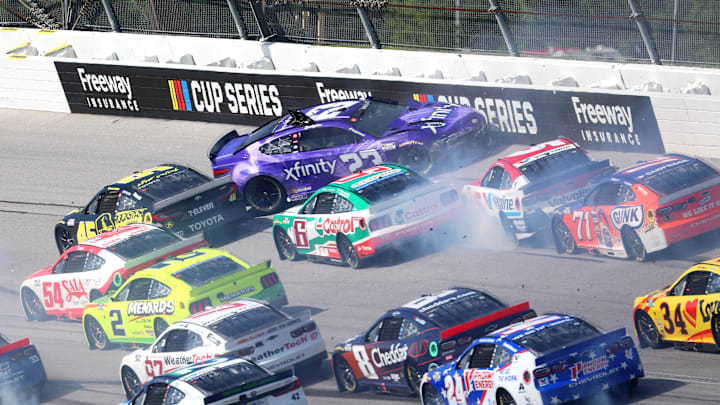
Business picked up in the second stage, but naturally, once it did, it only took 11 laps to junk two-thirds of the field after Ross Chastain turned Bubba Wallace to trigger the "Big One". Then, the rest of the afternoon was exactly what everyone feared it would be: double-file gridlock.
This wasn't racing. At no point during the event was it even possible to tell who the fastest car or most impressive driver was. It was only whoever ended up in the right place at the right time, based on how the pit stops shook out and who managed to escape the chaos with minimal damage.
If you watched Saturday's O'Reilly Auto Parts Series race, that was what a superspeedway race should be. Drivers could maneuver through the field and work their way to the front on their own merits. There will always be a heavy element of randomness involved at Talladega no matter what, but it at least felt like a true test of pack racing skill, and it was entertaining to watch.
Sunday's race did not feel like that, and the reason why is clear as day. It's not the stage lengths. It's not the fuel saving. It's the car. The Next Gen puts on absolutely putrid racing at Talladega and Daytona, and no Band-Aid solution will ever work without directly addressing that.
 Add us as a preferred source on Google