

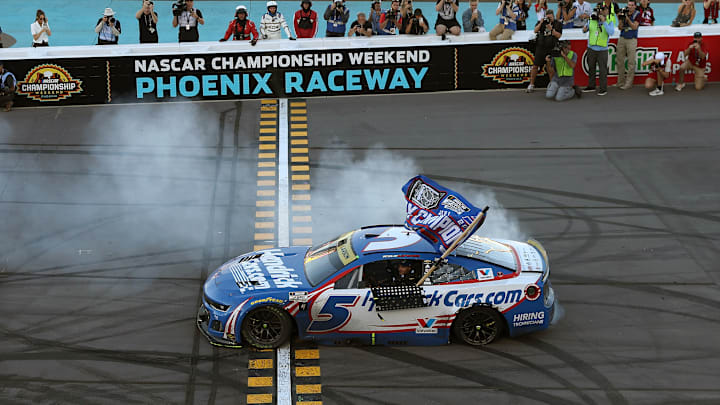
While there are a lot of fans who liked NASCAR's controversial playoff format, no less so than its most successful driver of that era, Joey Logano, it's safe to say that most are happy to see it go.
As Kyle Larson, who won both of his two career championships in the Championship 4 era, told Motorsport.com's Matt Weaver, it "ran its course," and the current style of the Next Gen car "deserved a format change".
The new "Chase" format, which is effectively a re-packaged, 16-driver version of the previous format used from 2004 to 2013, eliminates many aspects with which fans, media, and drivers alike had gripes for so long.
The "win and in" system, where a driver outside the top 30 in points could (and did) make the playoffs because of a surprise victory, is gone, along with the knockout style rounds and the one-race championship finale.
Now there is a 10-race shootout to end the season. Points are reset after the regular season, with bonuses awarded based on standings position, and the driver in the Chase field who has the most points after those 10 races wins the title.
“Personally, I liked the old [format].”
— PRN (@PRNlive) January 13, 2026
3x Champ @joeylogano was a fan of the old format, but is alright with NASCAR moving back to The Chase 🏆 pic.twitter.com/PL9VV2Hx7X
The NASCAR community has been begging for consistency to matter once again, and in a larger sense, it's back. Along with that, "win and in" has effectively been replaced with a 20-point advantage for race winners over second place, rather than just five.
Of course, there will be fans who don't like it, or think there weren't enough changes, but this is definitely aimed at striking a middle ground between the playoff supporters, and those clamoring for a full-season championship.
Ben Kennedy says had it not been for @markmartin being in the Playoff Committee meetings, he feels #NASCAR likely would have landed on a different format that wouldn’t have put as much emphasis on consistency. pic.twitter.com/TX7muis0YI
— Toby Christie (@Toby_Christie) January 12, 2026
Among all the changes for 2026, there is one major effect that many seem to be missing.
Due to the nature of the playoffs, your attention was often directed to drivers and situations that you wouldn't look for in a more typical situation.
If a driver already had a few wins by the mid-point of the season, his place in the playoffs was already locked up. So a DNF in any given race was seen as no big deal, because despite losing ground in the regular season championship, which awarded bonus playoff points, a driver could offset that loss by scoring another win, or by taking the top spot in a few stages.
Further to that, with almost nothing at stake for the top performers, fans were instead focused on the drivers around the cut line, whether it be the fight to make the playoffs, or an on-track battle to gain one extra point and advance to the next round.
Especially in the round of 16 or round of 12, those battles for transfer positions were often further down the field and between drivers who aren't household names or title contenders.
Chase Elliott is happy about the return of the intensity of the Chase 🔥 pic.twitter.com/j56Mt1Qgg3
— Sportskeeda NASCAR (@NASCARatSK) January 12, 2026
Remember the intense battle for the win at the Charlotte Motor Speedway Roval in 2018 between Jimmie Johnson and Martin Truex Jr.? Until the final turns, that battle was in a split-screen with a battle further down the field pertaining the final transfer spot.
It felt rather counterintuitive to be watching battles between drivers in 20th who were unlikely to play a factor in the overall outcome of the season, rather than some of the true contenders, even with just a few races remaining.
However, that is very likely to change with the re-introduction of the Chase in 2026.
Regardless of the big points advantage for wins, the only thing that affects seeding for the final 10 races are the point standings following the 26th and final race of the regular season.
Any DNF or big moment that costs a particular driver will have more jeopardy and storylines attached. It incentivizes fans to watch the things that really matter and feel more invested in the intensity and stakes that each race can bring.
NASCAR's return to a 10-race "Chase" championship format received high praise from series legend Dale Earnhardt Jr. pic.twitter.com/I4OoWKaHP8
— Motorsport (@Motorsport) January 12, 2026
Look at the 2025 Formula 1 season, for example. Was the racing product the greatest? Far from it. But the year-long title battle between Lando Norris and Oscar Piastri, and all the twists and turns that brought Max Verstappen within a shout of a record-setting comeback, created so much hype and anticipation as the season came to a close.
That's what NASCAR is targeting for the future: season-long storylines that get ratcheted up as the races count down, with the great separating themselves from the good over a sustained period. Albeit still manufactured to a degree, it beats the previous format.
While "elimination races" are now a thing of the past, drivers who don't perform throughout the regular season, and then in the Chase, will eventually eliminate themselves anyway, with no one-off victories to save them.
The cream will rise to the top, and it's all we'll be focused on for the final weeks of the season as the sport crowns its next champion. What more can you ask for?
 Add us as a preferred source on Google