

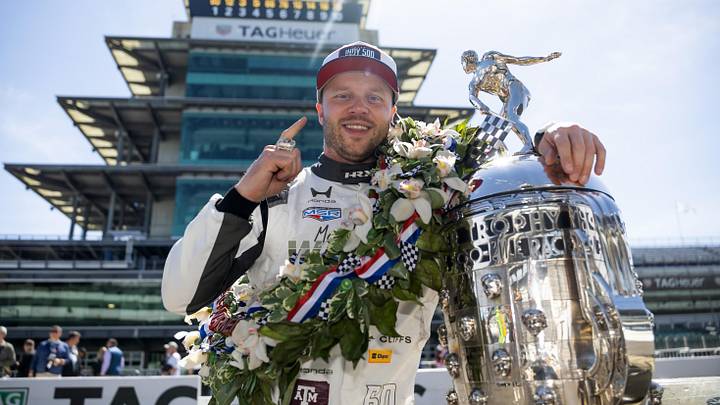
Meyer Shank Racing's Felix Rosenqvist entered this year's Indy 500 after having been consistently strong at the Speedway, Indiana oval over the years; he hadn't started worse than the third row since 2021.
Yet he was never truly considered one of the main contenders heading into this year's race, even after posting the fastest speeds in practice and the first two rounds of qualifying.
He also hadn't won an IndyCar race since 2020, when he earned his first career victory at Road America in only his second season in the series. His next podium finish, one of five he recorded between then at his Indy 500 victory, didn't even come until more than two years later.
Felix Rosenqvist breaks Indy 500 record, and we don't mean 0.0233 seconds
Rosenqvist's Indy 500 victory on Sunday was historic in more ways than one. The race's 70th and final lead change became the new all-time record, as did his 0.0233-second victory over Team Penske's David Malukas.
He also became just the third driver in Indy 500 history to win the race with an overtake on the frontstraighaway with the checkered flag in sight.
But perhaps most impressive of all is the fact that, in 109 previous editions of the Indy 500, dating back to 1911, no driver had ever won the race while riding a win drought as long as Rosenqvist's.
Even including the drivers who collected their first career IndyCar victory in the Indy 500, his 98-race win drought is an all-time record win drought among those snapped with Indy 500 victories.
Those 98 races do not include the two races he missed due to injury in 2021, or the Thermal Club exhibition race, in which he scored a podium finish back in 2024.
Yet even as he endured that long win drought, with close call after close call, perhaps none closer than his runner-up finish on the streets of Long Beach, California in April, he always believed it was only a matter of time before he won again.
"What I’ve always said in racing is that as long as you’re quick, things will happen," Rosenqvist told FanSided's Beyond the Flag. "Good things will happen to you. And there have been times in my career in IndyCar when I haven’t had the pace. That’s very worrying. When you don’t have pace, then you need to make big changes to your driving or the way you work with the engineers, the car.
"I feel like we had such good pace, like after Long Beach, for example, the momentum we’ve been through and then all the countless times I’ve been second or third in races through my career with different teams at different tracks, I don’t think I really doubted. I think the one, if anything, that I felt was a little harder was to win on an oval, to get that breakthrough result on an oval."
In eight seasons in the series, he had never even finished an oval race on the podium. So the fact that his breakout win came not only on an oval, but in the Indy 500, made it worth the wait.
"I actually don’t think I had a top three yet on an oval," he continued. "I think my best result was a fourth in Iowa [2023]. There are just so many moments in my career where I kind of had a perfect situation or leading a race and then something happened and I finished whatever. I didn’t really doubt it. I thought if I just keep knocking on that door, it's going to come for sure."
With those two late cautions in the Indy 500, he almost fell victim to "something happening" again. He had been in an extremely strong position after pitting under yellow on lap 130. All the leaders who stayed out still needed two more pit stops, while Rosenqvist knew he could save enough fuel to make it on one.
If not for those two yellows, which also included a brief red flag, he probably could have won the race by the widest margin in quite some time, rather than the narrowest margin ever.
"We were literally just ready; I passed Pato [O'Ward], and I was ready to just kind of say, okay, here we go, just brawl to the end," he explained. "I’m not sure if we were going to keep the lead. There might have been some repassing going on, but yeah, we were basically flat out to the end, and we played that game with Pato mainly, and some other guys, really well, where we were just kind of reeling it in.
"But then as soon as you start thinking about, ‘oh, this is like a perfect situation’, then the yellow comes out – and it always does that, by the way. If you ask any race car driver when you start thinking about the fact that you’re going to win, something happens. Definitely fell victim to that."
Fortunately for him, he only "fell victim" to running third with a lap to go. He still took matters into his own hands on the final lap and ran what has been described as the best lap ever at Indianapolis Motor Speedway, riding the outside of teammate Marcus Armstrong for almost the entire 2.5-mile oval before making the winning move, also fittingly on the outside, on Malukas, just before the finish line.
 Add us as a preferred source on Google