

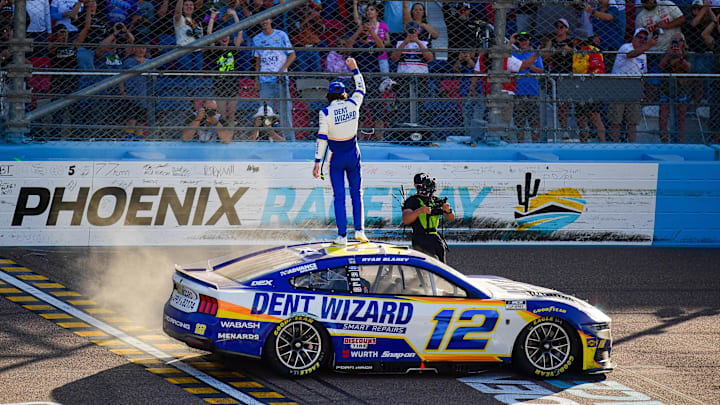
In Sunday's Straight Talk Wireless 500 at Phoenix Raceway, each driver in the NASCAR Cup Series field had to compete against 36 other teams. But Ryan Blaney had to compete against 37.
After driving from fifth to the lead in the opening stage, he was sent to the back of the field not once, but twice, after his pit crew left a wheel loose. It didn't matter, as he came all the way back to score his first win of 2026 by passing Ty Gibbs late and holding off a dominant Christopher Bell.
Blaney's effort is easily the most impressive of the young season. And it brings up a subject that never gets talked about in the scheme of NASCAR's eternal points system debate.
No points system will ever quantify that some wins carry more weight than others
On Sunday, Blaney earned a Pass Differential of plus-50. The next highest driver, Bubba Wallace, was a plus-34. And the 23XI Racing driver gained 22 of those 34 spots simply from the difference between his starting and finishing position. The 2023 series champion only picked up four that way.
This is even more insane than it looks.
— Ryan McCafferty (@rjmanalytics) March 9, 2026
Bubba had a +34 while gaining 22 spots from start to finish, that's 12 extra passes.
Gilliland had a +28 while gaining 18, that's 10.
Blaney gained four. And had a +50. He made 46 extra passes that he shouldn't have had to make. https://t.co/qh9Tjrx77b
Simply put, Blaney had to carry the whole world on his shoulders and then some. Yet ultimately, he scored 65 points, the standard number for a race win plus 10 bonus points for winning the opening stage. At the end of the year, that will probably come out to roughly an average score in terms of points for a winner.
When it comes to the beyond tired arguments about who "deserves" the Cup Series championship every year, and the lazy citations of the full-season standings as some gospel of ultimate truth, this is what always fails to be recognized.
No points system will ever measure the human component involved in the value of each finishing position, in which it must be understood that no two results are ever truly the same.
In a vacuum, these discrepancies will add up. A win like Blaney's on Sunday can only improve his average finish by as much as its numerical value allows it to. But in reality, it should be more than enough to cancel out his 27th place result in the Daytona 500 from being caught up in an accident not of his making.
At the end of the season, when fans take their make-believe points standings under a system no one has used for 23 years and present them as fact, no one will remember the circumstances behind the results.
It won't matter to anyone that Blaney's Phoenix win back in March was more impressive than, let's imagine, the seas parting for Chase Briscoe after the leaders crash on the last lap in the summer Daytona race.
But it should. Some wins are just better than others, and it's dishonest to pretend otherwise.
Stop watching box scores. You have eyes. They should be able to tell you who the best drivers truly are.
 Add us as a preferred source on Google