

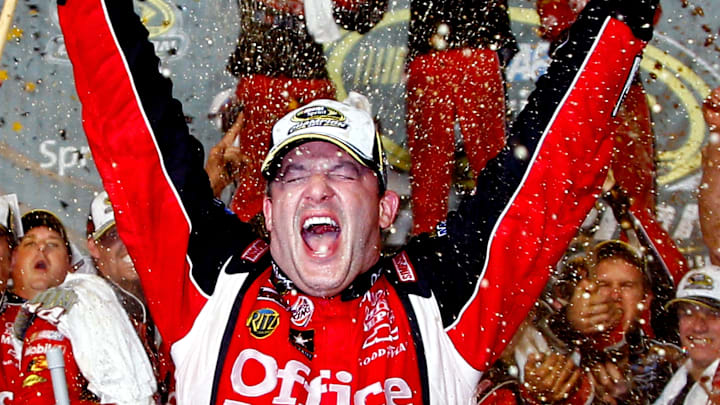
In the fall of 2011, 12 drivers qualified for the Chase for the Sprint Cup. In one of the most wide-open seasons in years, it felt like just about all of them had a chance. Yet nobody was talking about Tony Stewart, who was one of only two qualifiers for the postseason who hadn't yet won a race that year.
Stewart was trending downward at the wrong time. Two weeks prior to the points reset, he'd run a dismal 28th at Bristol Motor Speedway – on pure speed. His performance had been in a steady decline for the past several years, and at the age of 40, it felt like the beginning of the end. One of NASCAR's fiercest competitors just didn't have his fire anymore.
The first week of the Chase, he won on fuel mileage at Chicagoland Speedway. The next week, he won again at New Hampshire Motor Speedway. Suddenly, he was as hungry as ever. He won three of the final eight races, including the season finale to stun Carl Edwards on a tiebreaker to capture his third Cup Series title.
When he was on, there was nobody else in NASCAR who could grab a higher gear than Stewart. It's why he leads off our list of the top 10 greatest drivers in Cup Series history.
Tony Stewart was an unstoppable force, when he wanted to be
It might not be an exaggeration to say Stewart is the greatest pure racing talent of the 21st century. Before he was in the Cup Series, he was a champion in the Indy Racing League. He won a USAC Triple Crown title. He moonlit in the World of Outlaws with moderate accolades. Even long after his storied NASCAR career, he found success in NHRA Top Fuel drag racing. If it had four wheels, he'd drive it, and he'd win.
Now, this list is strictly based on Cup Series accomplishments, but Stewart's many additional endeavors do add context to a career had would have looked significantly better had he been groomed to race stock cars from the start. When he was a rookie in 1999, Jeff Gordon, who was the same age, had already racked up six years of experience at NASCAR's top level.
From that point forward, Gordon, who is widely considered a GOAT candidate, won 51 races and one title. Stewart won 49 and three. He competed against the greatest fields in NASCAR history, with Matt Kenseth, Dale Earnhardt Jr., Kevin Harvick, Kurt Busch, and Jimmie Johnson all entering the Cup Series ranks within three years of his first season.
The one knock on Stewart is that he could be his own worst enemy. He often distracted himself with petty feuds on the track that cost him valuable points, most notably in 2004 and 2006. At the same time, though, when he was locked in, it was over for the rest of the field.
That was clear in 2002, when he rebounded from an early string of awful luck to earn his first Cup Series championship. It was clear in 2005, when at one point he recorded an average finish of 3.5 over a 13-race stretch en route to his second title in dominant fashion. And it was clear in 2011, when after everybody and their mother had written him off, he willed himself to one last Herculean run of performances to remind the world who he was.
Stewart was as talented as any driver NASCAR has ever seen. His highs were as high as they could possibly come. He was without a doubt one of the all-time greats, when he wanted to be.
 Add us as a preferred source on Google