

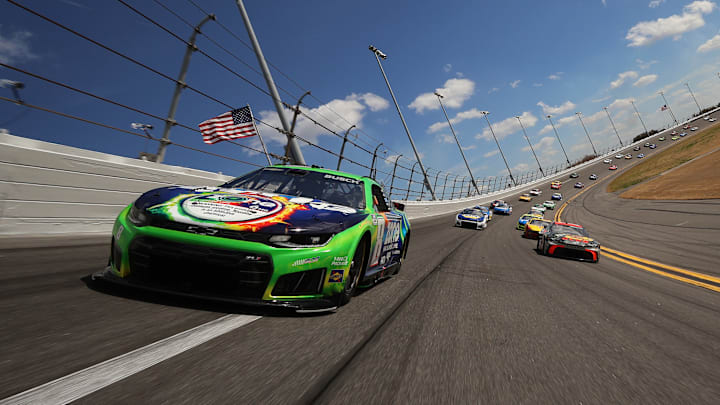
Without fully rehashing the details of our article from after Sunday's Daytona 500 about Kyle Busch's smart, yet needlessly criticized, move to intentionally drop back to 29th at the end of the "Great American Race", a move that resulted in him finishing 15th and gaining several positions from even before he started to drop back, suffice it to say that NASCAR Cup Series points racing is back.
It's what fans have clamored for over the past 12 years, throughout the entire era of "win and in" and the knockout Championship 4 playoff format.
It didn't take a rocket scientist to see that no matter what NASCAR did in light of the removal of the old format, there were still going to be complaints, and there were still going to be flaws with whatever new format was implemented.
And Busch exposed the one that was so blatantly obvious from the get-go, yet many fans saw fit to ignore, simply because the abolishment of the old format was supposed to be the greatest thing that ever happened to stock car racing.
NASCAR's new format is already broken
NASCAR upped the value of race wins from 40 to 55 points, effectively compensating, to a certain degree, for the removal of the true "win and in" nature from the new "Chase" postseason format.
Yet all of the other point values remained the exact same.
There is one single point between every single position from second place down to 36th, starting with 35 points for second, down to one point for 36th (and lower).
If you're not going to win, why risk a decent finish just to possibly pick up a handful of points at best?
We talk about consistency, consistency, consistency, and how this new points format supposedly awards consistency. The problem is that it rewards...consistency. It doesn't reward being consistently good.
Look at IndyCar's points format. The gap between a win (50 points) and second is 10 points. The gap between second and third is five points, and the gap between third and fourth is three. The gaps between each position from fourth to 10th are two, and point tallies only start to decrease by exactly one point starting from 10th to 11th.
Sure, the championships are often won by the drivers who maximize their points days, but it's about maximizing those points days on days you don't win. Nobody is going to win a championship, for instance, averaging seventh place points (26) per race. Such an average would have been good for fourth (and just a handful of points better than sixth) in 2025.
Likewise, nobody is going to win a Formula 1 championship averaging fourth place points (12) per race. Believe it or not, such an average would have only been good enough for fifth in 2025, since the gap between a win (25 points) and second is seven points, and the gap between second and third (and third and fourth) is three. Point values decrease by two points per position from fourth to ninth, before dropping by one to award the 10th place finisher a single point. Nobody else scores.
But in the Cup Series?
Even if you add in the new bonus 15 points for race victories, the 2025 champion, based strictly on race results (excluding stage results) would have been Christopher Bell with 999 points. That's just over 27 points (an average of 10th place) per race.
NASCAR has technically incentivized winning, even after de-incentivizing winning; sure. But beyond that, they have incentivized riding around collecting points.
Why try to finish fifth if you have an eighth place car, if you're more likely to end up in the wall in 32nd if you actually go for a bold move?
In IndyCar and Formula 1, there is more incentive to climb the leaderboard. The higher up you climb, the more points you advance when you gain another position.
In NASCAR, the gap between second and third is the same between 35th and 36th. It's a fundamental flaw that took only one race to expose.
Fortunately, NASCAR has listened to fans a lot more lately than they have in the past, namely with the whole postseason overhaul than some fans never believed would actually happen. Let's hope a true points format overhaul, not a "here are 15 extra points for winning!" bandage, that actually rewards being consistently good comes next.
 Add us as a preferred source on Google