

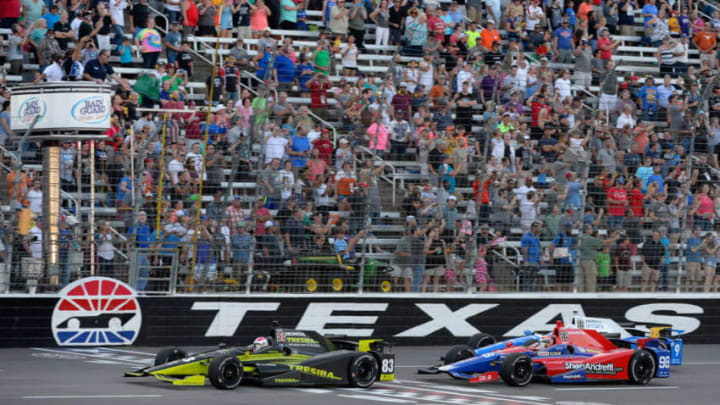
IndyCar’s third longest oval has provided a lot of excitement or a lot of heartache. How much can history tell us about what will happen in 2018 with the UAK18 aero kit?
Texas Motor Speedway is mostly associated with NASCAR. However, IndyCar has raced at “The Great American Speedway” uninterrupted since the Indy Racing League’s founding in 1996. The Speedway is home to IndyCar’s third longest oval currently on the schedule behind Indianapolis Motor Speedway and Pocono Raceway. As such, the racing has been either very good or very bad. As we countdown to the race at Texas, here is a look back at the last five races at Texas Motor Speedway.
2013
The 2013 race would be the last 228-lap race at the track, as the following year, IndyCar would increase the race distance to 248 laps. The race saw the fewest lead changes ever at the track with only four. As such, Team Penske’s Helio Castroneves, who started in sixth place, led the race’s final 132 laps. Andretti Autosport’s Marco Andretti led 57 laps, but he could only manage a fifth place finish. The 2013 race is also notable for being one of the cleaner IndyCar oval races with only three caution flag periods and two DNFs.
2014
The 2014 race was much like the 2013 edition. A Team Penske car led the most laps (Will Power, 145), but he couldn’t get the win. Despite five retirements, it was still one of the cleaner races at the Speedway with only three caution flag periods. Ed Carpenter led a total of 90 laps across four stints, including the final 35 laps, en route to the win. Josef Newgarden, then racing for Sarah Fisher Hartman Racing, had a race to forget after qualifying in second place. The then 23-year-old suffered from poor grip and decreased power from SFH Racing’s Honda engine.
2015
The 2015 race saw a return to wheel-to-wheel oval racing, as several drivers took a shot at running out front with 14 lead changes, but unlike in previous years, no driver led a triple-digit la total, and until the final dozen laps, anyone in the top four could have won. While winner Scott Dixon’s margin of victory was 7.800 seconds, until the final round of pit stops, it was very close. The previous year’s winner and second place starter Carpenter as well as his teammate Newgarden had issues with their Chevrolet engines within two laps of one another and were both forced to retire.
2016
After 248 laps and 76 days, the winner for the 2016 race was decided by a whisker, quite literally, as Rahal Letterman Lanigan Racing’s Graham Rahal pipped Schmidt Peterson Motorsports’ James Hinchcliffe by 0.008 seconds to the checkered flag. The race finish is Texas Motor Speedway’s closest ever. The final restart took place with eight laps remaining, and on the final lap, Rahal went inside on Hinchcliffe as the Canadian struggled for grip. Chip Ganassi Racing’s Tony Kanaan snuck in behind Hinchcliffe for third after Hinchcliffe made a last-second charge on the front stretch that did not work out for him.
The race was red-flagged after Dale Coyne Racing’s Conor Daly and Ed Carpenter Racing’s Newgarden crashed in turn four before it began to rain. The race was suspended with 71 of 248 laps completed for 76 days before it resumed and the final 177 laps were completed.
2017
The 2017 race was less of racing and more of a demolition derby as 12 cars crashed out. Prior to the race, drivers were already skeptical about Texas Motor Speedway’s recent resurfacing and said that it felt dangerous and like being on ice despite testing there earlier in the year.
More from IndyCar
- IndyCar: Two teams with no drivers confirmed for 2024
- IndyCar: Chip Ganassi Racing news hints Alex Palou announcement
- IndyCar: ‘Addition by subtraction’ could pay off in a big way
- Team Penske should make a bold driver signing for 2024
- IndyCar: 5 teams that still have open seats for 2024
That proved true after Andretti Autosport’s Alexander Rossi crashed in turn three on lap 37. Team Penske’s Castroneves then crashed in turn two on lap 91. Then came the “big one”, a eight-car pile-up in turn three that Chip Ganassi Racing’s Kanaan accepted fault for causing. This led to race control establishing competition cautions throughout the rest of the race for tire wear. Team Penske’s Newgarden would then be involved in a one-car accident in turn four on lap 201.
Then with four laps to go, four cars crashed in turn one, making it the first time in an IndyCar race that more than half the grid crashed out on all four corners of an oval. The resulting mess left nine cars classified as running and the race finishing under caution with Team Penske’s Power taking the win.
Next: 10 non-racing drivers who should drive in the Indianapolis 500
Will the 2018 race be a repeat of last year’s demolition derby or will we see the close racing of 2015 and 2016? With the new UAK18 aero kit providing less downforce in the speedway configuration, it’s a flip of a coin, but it’ll be exciting to watch.
 Add us as a preferred source on Google