

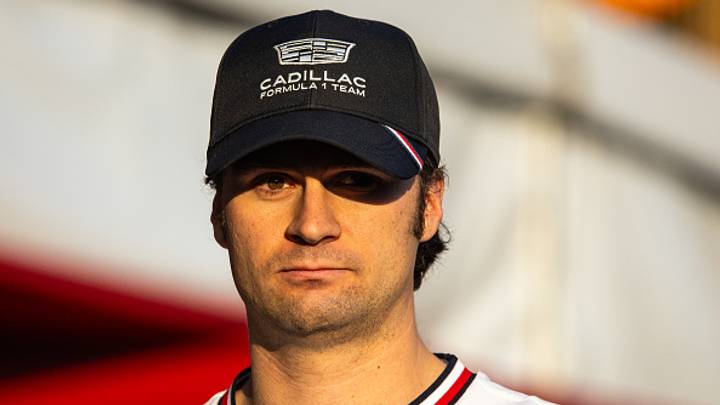
Colton Herta left IndyCar for Formula 2 after seven seasons for what he believed would be a quicker and more reliable route to obtaining his FIA Super License, which would make him eligible to compete for Cadillac's Formula 1 team as early as 2027.
He entered the year with 35 points, thanks to his three most recent IndyCar championship results of 10th in 2023, second in 2024, and seventh in 2025, leaving him needing five to achieve the required 40 to secure the license.
But it's been a disastrous F2 season for the 26-year-old American with Hitech, as he's 19th in the standings with just two race weekends remaining on the 2026 schedule.
Ironically, he is now unable to secure any points through Formula 2 in the same season that saw former Andretti Global teammate Kyle Kirkwood become a Super Licensee himself with his runner-up IndyCar championship finish. Herta has instead needed to rely on Formula 1 free practice sessions.
Herta's rough season, coupled with the success of Kirkwood and the resurgence of Andretti Global as a whole, are among the many reasons his decision to give up his IndyCar seat for the chance of driving one of Formula 1's slowest cars has been questioned time and time again throughout the year. But F1 has always been his real dream, and he has kept at it.
He drove the Cadillac car in free practice in Barcelona, Budapest, and Austin, with his other appearance in Monza not counting because it didn't last long enough.
So he still needed two points entering the Grand Prix weekend in Mexico City, where he again ran a free practice session. Yet both his team and the FIA seemed to be under the impression he only needed one more point.
The reason why is an utter embarrassment in every sense of the word.
For some reason, Cadillac and the FIA (and Herta isn't totally absolved from blame here, either) thought he finished in sixth place in the 2025 IndyCar championship.
And somehow, it's supposedly IndyCar's fault for the communication breakdown.
An archived version of the IndyCar standings page from May 10, 2026 does indeed show Herta in sixth, not seventh. But it accurately shows him tied with Felix Rosenqvist, and IndyCar's tiebreaker has long been top race finish. Rosenqvist recorded a runner-up finish, while Herta finished no higher than third.
So Herta finished seventh in 2025, and at no point from the 2025 season finale (at which point Rosenqvist was indeed listed sixth) until now, more than a year later, would that have changed.
According to ESPN's story on the comical error, "The FIA did not have immediate access to the IndyCar official data as it is not an FIA-regulated championship."
What? Is that really an excuse? What are we even doing here?
It's not a FanSided-regulated championship either, yet FanSided (and every other motorsport news outlet on the planet) still had access to the results of the 2025 season which placed Herta seventh, not sixth. And nobody in their right mind would have believed that that would have changed at any point in 2026.
In essence, the system that regards IndyCar as a minor league series to begin with, and doesn't give nearly enough credit to its championship results in terms of Super License points as it is, reportedly doesn't care enough to actually look at those results to ensure any degree of accuracy whatsoever.
But that's not even the best part of the whole mess. The best part is the fact that there was (and still is, after the pre-2026 rework of IndyCar's Super License point values) actually a two-point difference between sixth and seventh place in the IndyCar standings. So Herta would have entered the year with 37 points, needing just three more.
He would have entered Mexico with 40, the points requirement already met, and that extra session would have taken him to 41.
And nobody thought to question why he still needed another FP1 session after running his third in Austin?
Even with the website flaw, this is strictly a Cadillac and an FIA issue, as neither one should be excused for failing to verify the results or reconcile the points. So the fact that we've sunk to blaming IndyCar's website over an F1 eligibility issue is preposterous.
But perhaps it's yet another unsurprising example of the shambolic elitism that tends to exist within the whole FIA Super License system and ladder to F1 when it comes to the lack of value, and really the level of complete disrespect, placed on American motorsport. Driving in a single Formula 1 practice session, for example, is valued as much as finishing in the top 10 in the IndyCar championship.
Open up Wikipedia, for crying out loud. Add the IndyCar race results and points up in Google Sheets. Download a phone calculator app. Or, dare I say it, it's 2026; ask ChatGPT. Or perhaps easiest of all, learn how the series' tiebreakers work, when two drivers are listed with 372 points, rather than glancing at the screen and immediately closing the tab, assuming everything is good to go.
IndyCar's fault, though, because for as prim and proper as the FIA and the other usual suspects like to believe they are, they evidently can't do anything more than Google "IndyCar points" to determine whether or not an F1 hopeful should be allowed to compete.
At the end of the day, Herta getting to 40 wasn't an issue with how many races still remained on the 2026 Formula 1 calendar. He ended up getting it this past weekend in Sao Paulo anyway. So if the mix-up weren't so pathetic, it would actually be kind of hilarious.
Now we're just wondering what they'd do if IndyCar decided to overturn the Team Penske push-to-pass penalties from 2024 and Herta loses second in the championship standings. Can you imagine? Just don't rely on the FIA to do the math.
 Add us as a preferred source on Google