

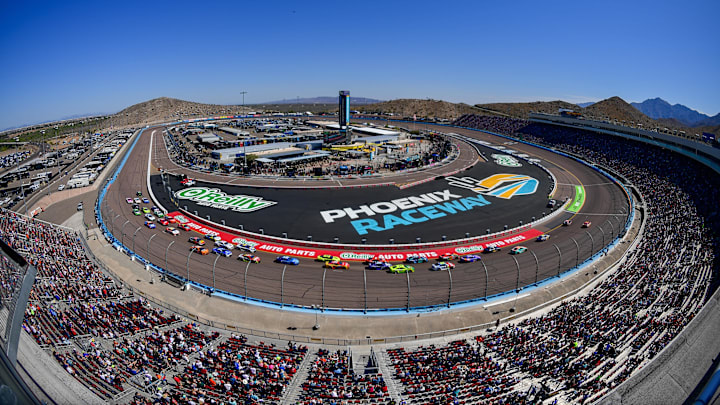
For the first time in 2026, a driver not named Tyler Reddick won a NASCAR Cup Series race on Sunday when Ryan Blaney put together a heroic effort to overcome multiple pit road issues and win the Straight Talk Wireless 500 at Phoenix Raceway.
While Reddick still maintains a sizeable points lead even without winning a fourth consecutive race, Blaney's win vaulted him up into second in the standings. Blaney's incredible Pass Differential of plus-50 speaks to how masterful of a drive he put together, but it also highlights the bigger picture from Sunday's race.
Blaney's talent behind the wheel was the driving factor behind his ability to overcome the adversity and get his way back to the front, but the points-paying oval debut of the 750-horsepower increase this season should not be ignored, either.
The package, which is designed to be used at road courses and ovals measuring less than 1.5 miles in length, certainly made an impact in Sunday's race. Phoenix has never been known for delivering consistently good racing and was justifiably pulled from hosting the championship race after six years, in favor of Homestead-Miami Speedway, but it put on a much better show this time around.
Tire issues plagued multiple drivers throughout the race, including Chase Briscoe, but there were battles on track during the 312-lap event and a lot with which to be encouraged under the increased horsepower package.
Horsepower increase delivers encouraging race at Phoenix
According to The Athletic's Jeff Gluck, there were 23 lead changes at Phoenix on Sunday, the most at the track since 2013.
There were 23 lead changes at Phoenix today, the most since 2013 (also 23 that day).
— Jeff Gluck (@jeff_gluck) March 9, 2026
The horsepower increase was not the only factor that played a role in Sunday's race, as teams also used the same Goodyear tires from the championship race at Phoenix that were intended to produce more wear. Aside from the tire issues throughout the day, it is safe to say that the difference was noticeable.
Aside from the 60-lap opening stage that went caution-free, there were not many long runs in a race that tied a track record for cautions (12). However, it was clear after the rubber had been laid down that some drivers were better than others over a long run and were able to make up ground and move their way toward the front.
Take Blaney, for instance. He was able to put his No. 12 Ford Mustang below the apron in turns three and four of the four-turn, 1.022-mile (1.645-kilometer) Avondale, Arizona oval.
Christopher Bell, who led a race-high 176 laps, had no issue making his way through the field, while polesitter Joey Logano was noticeably lacking some of that long-run pace and faded over the longer runs until he was involved in multiple incidents in the final stage.
Even Kyle Larson, who fought an ill-handling car for most of the opening half of the race, drove his way back up to third by the finish, further highlighting the improvements that the increase in horsepower and enhanced tire wear produced.
This package is in line to be tested some more when teams head to Darlington Raceway on Sunday, March 22, Martinsville Speedway on Sunday, March 29, and Bristol Motor Speedway on Sunday, April 12, three tracks that have failed to produce the passing and excitement in recent years that fans have come to expect.
If Phoenix is any indication, don't be surprised if there is an uptick in passing and these races are more compelling overall. It is easy to overreact to just one race, but for a track known for its lack of passing and competitiveness, Phoenix offered an encouraging sign for fans that maybe NASCAR has found something it can work with on shorter layouts.
 Add us as a preferred source on Google