

Everybody always seems to want to talk about what the NASCAR Cup Series standings would look like if there were no postseason at all, and therefore no post-regular season points reset.
But what if, instead of reverting to a full-season championship format or going back to an iteration of the Chase format that was used from 2026 (which NASCAR actually did), NASCAR had kept the old "win and in", knockout-style playoff format for one more year?
One of the main advantages to the 10-race Chase setup that NASCAR uses again is the fact that no longer is a driver's entire nine-month, 36-race season reduced to the volatility of a three-week round in which getting hot (or going cold) within a stretch of 15 days can make all the difference.
And that's why a comparison between what the current standings actually look like, versus what they'd look like under the 2014-2025 format, shows just how much things have changed, even if technically meaningless.
We have already documented that Shane van Gisbergen, not Austin Cindric, would have made it into the 16-driver postseason under "win and in". Van Gisbergen, along with Chase Elliott, Daniel Suarez, and Chris Buescher would have been eliminated in the round of 16.
A full breakdown of that math was explained after the season's third playoff race at Bristol Motor Speedway, which would have been the first cutoff race to narrow the postseason field down from 16 drivers to 12.
The drivers eliminated in the round of 12 would have been Carson Hocevar, Bubba Wallace, Ty Gibbs, and Ryan Preece. Based on their points reset values under the old format, they would have ranked ninth through 12th in the standings, and none of them won at Kansas Speedway, Las Vegas Motor Speedway, or Charlotte Motor Speedway, the three tracks that would have made up the round of 12.
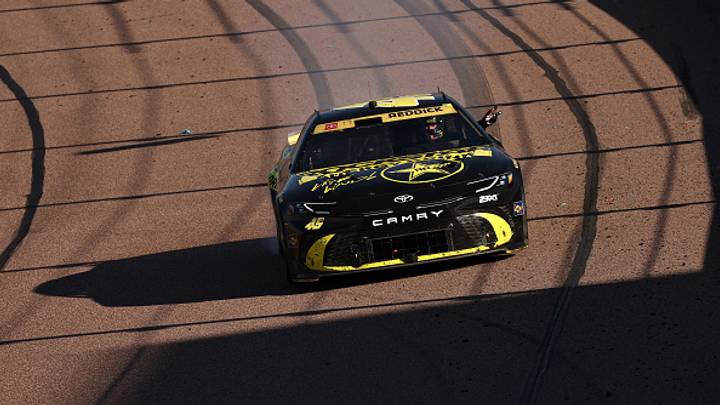
So Tyler Reddick's victory on Sunday would have locked him into the Championship 4, since he would have been among the eight to advance to the round of 8, with a fifth-place points finish in the round of 12.
On the flip side, Kyle Larson, despite a red-hot start to the postseason in which he scored two wins, two runner-up finishes, and two other top six finishes, would be well outside the cut line, simply because of the timing of the post-round of 12 reset. In reality, he's still leading the standings, even after his Phoenix disaster.
And that's hardly the only difference worth nothing. Here's what the standings would have looked like after Phoenix, the first "round of 8" race, under the old format.
NASCAR Cup Series standings under previous "win and in" format
Rank | Driver | Points | Gap | Cutoff | Actual position |
|---|---|---|---|---|---|
1 | Tyler Reddick | 4096 | 0 | LOCKED IN | 7th (-56) |
2 | Ryan Blaney | 4082 | -14 | +18 | 5th (-40) |
3 | Joey Logano | 4072 | -24 | +8 | 6th (-44) |
4 | Chase Briscoe | 4067 | -29 | +3 | 3rd (-24) |
5 | Christopher Bell | 4064 | -32 | -3 | 2nd (-5) |
6 | Denny Hamlin | 4061 | -35 | -6 | 4th (-31) |
7 | Kyle Larson | 4026 | -70 | -41 | 1st (+5) |
8 | William Byron | 4024 | -72 | -43 | 14th (-190) |
First of all, none of the drivers in the top three here are in the actual top four, which speaks to just how much consistency over the entire 10-race postseason is now valued, versus the old format.
Sure, a bad race can still damage your championship chances, but that's no longer the case simply because of when it happens. Likewise, a win no longer renders the next race or two meaningless, simply because of when it happens.
Reddick being 56 points out the real points lead, rather than leading with his Championship 4 ticket punched with two round of 8 "bye week" races to go, proves it.
And then there's William Byron, who somehow would have made it to the round of 8 on points (we're not exactly sure how, seeing as he's 14th in the actual Chase).
He would have been the 12th and final driver to make it from the round of 16 to the round of 12, and he would have been the eighth and final driver to make it from the round of 12 to the round of 8.
Nothing speculatar. But believe it or not, more than enough to have a legitimate chance at the championship.
Seeing as how he won his way to the Championship 4 at Martinsville Speedway a year ago, there's a very real chance that he would still be in title contention this year, despite having had a completely lackluster season.
But under the Chase format, he's all but eliminated, sitting 190 points behind with just 228 points left on the table.
Even if he wins all three races to conclude the season, which is highly unlikely, you're talking about an eighth to 10th place finish, rather than a guaranteed championship simply because of when those wins occur.
All in all, we're well aware that this chart means nothing. Everybody knows the rules and plays by the same rules. But it's a useful tool to illustrate just how different things truly are under the new format, and many would argue that it's a perfect illustration why the Chase was the way to go, rather than "win and in".
The YellaWood 500 is set to be shown live on NBC from Talladega Superspeedway starting at 2:00 p.m. ET this Sunday, October 25. Begin a free trial of FuboTV and don't miss any of the action from the sport's largest oval!
 Add us as a preferred source on Google