

On July 14, 2001, one of the biggest upsets of the NASCAR season occurred when 25-year-old Busch Series driver Jimmie Johnson won at Chicagoland Speedway for Stanley Herzog's low-budget team. A hard-charging Ryan Newman blew a tire, and the El Cajon, California native saved enough fuel to make it the distance, immediately putting himself on the map for bigger and better opportunities.
The following year, he was driving in the Cup Series for Hendrick Motorsports. Not much was expected from the rookie, who had no shortage of doubters to prove himself to. He joined champion teammates Jeff Gordon and Terry Labonte in a brand-new extra car for the organization, and it was going to be a challenge to keep up.
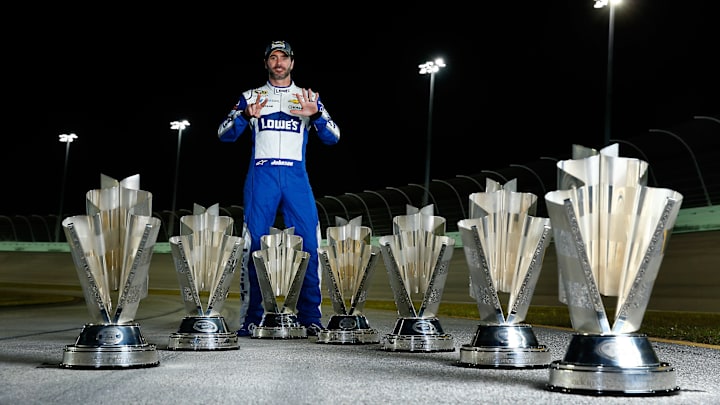
Over the course of the next 19 seasons, Johnson won 83 Cup Series races and seven championships during the most competitive era NASCAR has ever seen. He compiled the best winning percentage of any Cup Series driver of the past 45 years. He won titles under two different postseason formats and in three different generations of race cars.
He was the greatest of all-time.
Jimmie Johnson was inevitable, when inevitability was supposed to be impossible
To this day, Johnson's legacy is often disputed because of the unpopularity of the Chase for the Cup, and later the playoffs.
But let's look at it this way. NASCAR's postseason, as fans will never cease to remind you, was designed to manufacture storylines. It was designed to promote chaos. It was designed to condense the body of work of a full season into a 10-race shootout, later rounds of three and then one winner-take-all finale.
It wasn't designed so that a driver could win five consecutive championships.
Nobody does that. In any sport. Not in the past 50 years. In major pro sports, you'd have to go back to the Boston Celtics' run of eight straight between 1959 and 1966 and the Montreal Canadiens' run of five between 1956 and 1960, and the latter did so when there were only six teams in the NHL. The last time it's happened at any level was when the UCLA men's basketball team won seven in a row between 1967 and 1973.
Johnson's five-in-a-row streak between 2006 and 2010 is one of the greatest accomplishments, and possibly the most underappreciated one, in all of sports. Winning three in a row was historic enough, when he joined Cale Yarborough as the only other driver to ever accomplish such a feat. Winning four was unprecedented. Winning five was just outright inconceivable.
Oh, "But he didn't always score the most points all season, those titles are tainted!"
Make no mistake, this was entirely by design. Nearly every Johnson title followed the same trend: a red-hot start, a cold spell over the summer, and then he'd ramp it up again in the fall. He and the No. 48 team knew they were the best, so they were willing to give away points when they mattered the least, often experimenting with riskier setups to help them prepare for the races that mattered the most.
Under a full-season points format, Johnson could have easily won seven championships there too, and probably more races than he won in reality. You can make a convincing argument (at least, to anyone open-minded enough to listen) that he would have been even more successful without the Chase.
And consider who Johnson did his damage against. He did it against Gordon, whose peak mysteriously ended the moment his teammate's began. He did it against Tony Stewart. He did it against Kyle Busch and Denny Hamlin and Matt Kenseth and Kevin Harvick. NASCAR had never had a more loaded class of superstars all in their primes at the same time, and he made them look mortal.
None of what Johnson did was ever supposed to happen. His entire career, for that matter, was never supposed to happen. He was a complete unknown, suddenly thrust into one of the best seats in the Cup Series because of one fortuitous Busch Series win. He arrived because of some totally random stroke of luck.
He stayed because he was the greatest to ever do it.
 Add us as a preferred source on Google