

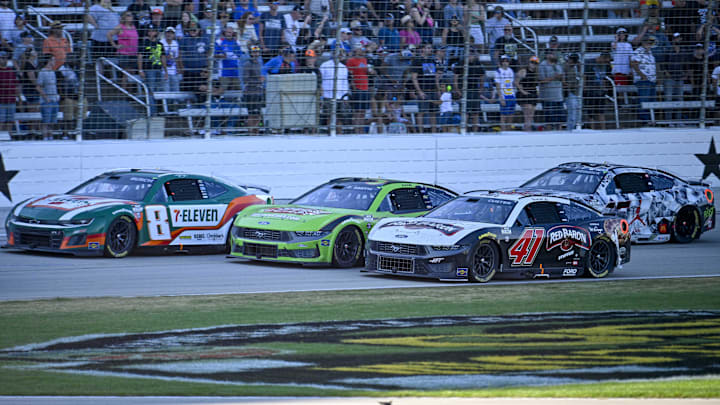
Sunday's Jack Link's 500 at Talladega Superspeedway produced an exciting finish, as Carson Hocevar surged ahead of Chris Buescher in the tri-oval to pick up his first career NASCAR Cup Series win. He even tacked on a memorable post-race celebration for good measure in front of the raucous Talladega crowd.
While a massive crash in the second stage collected 26 drivers in the 40-car field, the superspeedway package once again failed to deliver an exciting race from start to finish, despite NASCAR's decision to tweak the stage lengths.
Furthermore, the 98-lap opening stage went caution-free, which continued a trend this season of races primarily running green and featuring a historically low amount of cautions. Just one week prior at Kansas Speedway, the entire race went without a single caution for incident until Cody Ware spun in turn four as Denny Hamlin was coming to take the white flag.
Don't be surprised if that trend comes to an end in Sunday's Wurth 400 at the 1.5-mile Texas Motor Speedway, a track that has typically not put on the best racing and constantly delivered a lot of attrition in the Next Gen era (since 2022).
Texas could make up for lack of cautions this season
According to NASCAR Insights, 2026 has seen the fewest cautions through 10 races since 2012, and stage cautions only began in 2017. That trend, however, could be tested this weekend, considering Texas has produced more cautions per race (14) than any other active track in the Next Gen era.
2026 has seen the fewest cautions through 10 races since 2012
— NASCAR Insights (@NASCARInsights) April 30, 2026
But the trend could be tested this weekend, Texas has produced more cautions per race than any other active track in the NextGen era
Average cautions per race:
Texas - 14
Charlotte - 12
New Hampshire - 10 pic.twitter.com/HqNORNSFSt
It is no secret that racing at the Fort Worth track has declined since it was reconfigured in 2017. With that said, all four Next Gen points races at Texas have produced at least 11 cautions, including 16 apiece in the 2022 and 2024 races.
There have also been 20 or more lead changes in each of those events, which speaks to the unpredictability that Texas has become known for lately as drivers struggle to put clean and mistake-free races together.
Look no further than last year's winner Joey Logano, who had finished no higher than eighth all season entering the race, before he overcame a rash of cautions and prevailed after a thrilling late-race battle with Michael McDowell.
Of course, there is no guarantee that drivers will face the same issues again, but judging by recent history, the chaotic nature of Talladega might just transfer over to Texas once more on Sunday.
Outside of the 12 cautions at Phoenix Raceway earlier this season, which matched a track record for the series, the majority of the races have seen lots of green flag action, with few stops along the way. A lot of that could be attributed to drivers trying to maximize their points each race, with race wins no longer vaulting them into playoff contention.
Regardless, it is hard to see that trend continuing throughout the summer months. Texas has had its history of chaos, and Charlotte Motor Speedway has as well, as Memorial Day Weekend's Coca-Cola 600 approaches.
The sport's best are set to continue to be tested at a diverse set of tracks over the next few months, and Texas should not be overlooked. It may not be known for great racing, but if history is any indication, the caution flag may be flying a little more on Sunday than usual at a track that has become one of the most treacherous in the series.
 Add us as a preferred source on Google