

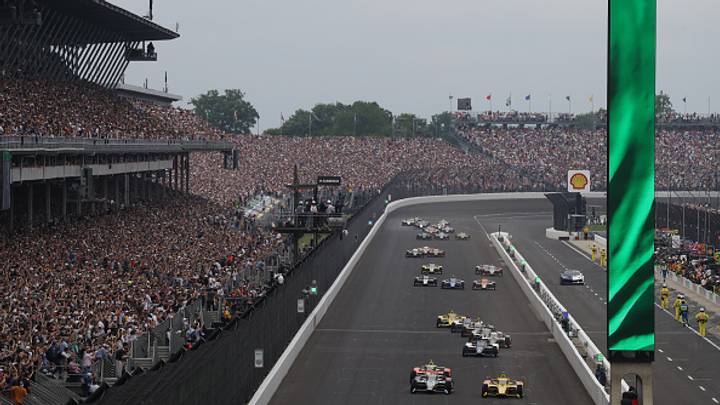
While there has long been somewhat of a belief that, in the 16th and final year of the current DW12 chassis, teams would be more willing to field additional entries for the Indy 500, the one and only race on the IndyCar calendar for which the field is not restricted to the 25 full-time chartered cars, that does not appear that it will be the case.
According to a recent article by RACER.com, there is already speculation that the series may need to intervene, just as they did this past season, so that the field of 33 in May's 111th running of the Indy 500 at Indianapolis Motor Speedway is indeed a field of 33.
The series is set to see 11 full-time teams competing next year, after Dreyer & Reinbold Racing purchased a charter from Rahal Letterman Lanigan Racing amid the latter's downsize from three cars to two. Dreyer & Reinbold Racing have not competed full-time in the series since 2012, and they are set to be the sport's only one-car team in 2027. There are four three-car teams and six two-car teams.
No 11th row of 3 in 2027?
Only four of those multi-car teams are currently planning to run an additional entry for the Indy 500. Ryan Hunter-Reay has been confirmed as Arrow McLaren's fourth driver for the second straight year, while Helio Castroneves is expected to make his sixth attempt at a fifth Indy 500 win with Meyer Shank Racing.
Ed Carpenter Racing should once again field a third car for Ed Carpenter, while A.J. Foyt Enterprises' third car seems like a no-brainer for former full-time driver Santino Ferrucci, who is a record eight-for-eight in terms of top 10 Indy 500 finishes.
The third Foyt car was the car IndyCar played in a role in getting onto the grid this past season, through a partnership with HMD Motorsports.
The other two additional entries are expected to come from Dreyer & Reinbold Racing, which have fielded two cars each year since 2022, despite having not run a race other than the Indy 500 since 2020, and Abel Motorsports, which made their first Indy 500 appearance since 2023 this past May with Jacob Abel behind the wheel.
The current reduction from 2026 comes squarely from Rahal Letterman Lanigan Racing, which fielded four cars (three full-time and a one-off for Takuma Sato) and now plan to run only their two full-time entries. Sato has been in the race for 17 consecutive seasons and is set to turn 50 in January.
If May's 200-lap race around the four-turn, 2.5-mile (4.023-kilometer) Speedway, Indiana oval consists of fewer than 33 cars, it would mark the first time that's happened since 1947, when there were just 30. And that was largely the case because of the withdrawals due to the ugly American Society of Professional Auto Racing (ASPAR) labor dispute.
The field size has officially been capped at 33 since 1934, with the only two exceptions coming in 1979 and 1997, when there were two additional cars to comprise a field of 35 both years.
Will one of the other teams step up and add an entry on their own, or will IndyCar have to come to the rescue not once but twice to take the current car count of 31 and get it to 33, so that there can once again be 11 rows of three taking the green flag on Memorial Day Weekend?
Either way, bumping looks unlikely for the second year in a row, after there had been three consecutive Bump Days from 2023 to 2025.
 Add us as a preferred source on Google