

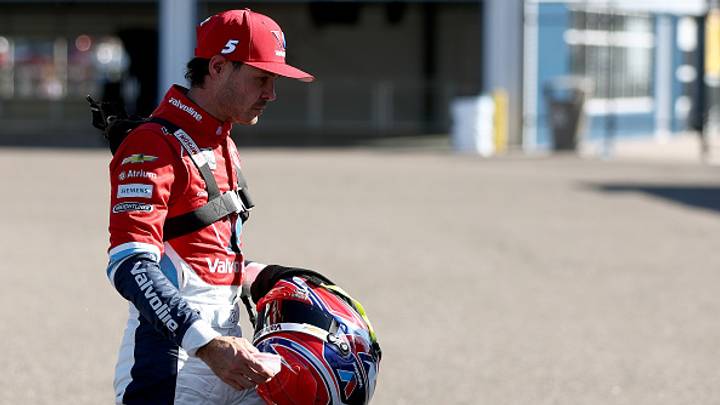
A few weeks ago, all we could talk about was how Kyle Larson was supposedly steamrolling his way to another NASCAR Cup Series championship.
How it was clear that he and the No. 5 Hendrick Motorsports team were holding something back during the regular season and saving it for the playoffs, which they started with two wins, two runner-up finishes, and two other finishes inside the top six in the first six races, after scoring just one top two result pre-playoffs.
How the championship wouldn't even get to Homestead-Miami Speedway.
And how it was over because Larson, not Toyota, was the big winner from the crucial stretch of three races on 1.5-mile ovals on which Toyota was supposed to dominate.
That all aged really well, didn't it?
One bad race, and this championship fight is wide open with three to go. Seventh-place Tyler Reddick went from 114 points behind to 56 points behind with his first win since April this past Sunday at Phoenix Raceway.
With Reddick still in seventh after making up 58 points (more than half) of the deficit with which he entered the week, it looks like we could have a legitimate seven-way fight on our hands over the season's final three races.
Larson, who did not finish the race after dealing with multiple issues before ultimately hitting the wall with a flat tire, entered the 312-lap Freeway Insurance 500 around the four-turn, 1.022-mile (1.645-kilometer) Avondale, Arizona oval with a 49-point lead over Joe Gibbs Racing's Denny Hamlin.
Now he's just five points ahead of Joe Gibbs Racing's Christopher Bell, 24 ahead of Joe Gibbs Racing's Chase Briscoe, 31 ahead of Hamlin despite Hamlin's own disastrous afternoon, 40 and 44 points ahead of Team Penske teammates Ryan Blaney and Joey Logano, respectively, and 56 ahead of Reddick.
And it's exactly why fans wanted this new format.
First and foremost, Reddick's first win in six months didn't punch his "Championship 4" ticket like it would have. So the value of having a 10-race Chase, rather than three three-race knockout rounds and a single-race title decider, is self-explanatory. His mid-season struggles still matter, which would not have been true a year ago.
Second of all, Larson's awful Phoenix race would have been disastrous for his championship hopes. Since it would have kicked off the old "round of 8", he'd basically be in a must-win situation. But an extraordinarily strong start to the playoffs means that, while he was undoubtedly the biggest loser of the Phoenix race, he's still in control of the championship, as he should be.
Third, NASCAR's removal of "win and in" was countered by the bonus 15 points now give to race winners. While that did open up the door for a driver to potentially run away with the title by winning multiple Chase races, it also opened the door for the championship battle to be turned upside down by an underdog getting hot at the right time.
And seeing as how no driver has won more than six total races of an entire season during the Next Gen era, the latter was always more likely than a single driver reeling off four or five wins in the 10-race postseason to put it away with two or three races remaining.
Just look at Briscoe. Three weeks ago, he was 123 points behind. With two wins and an eighth place finish since, he's cut that deficit by 99. And that's even with Larson only having a single bad race over that stretch.
And most importantly, there are no more artificial eliminations. There is nothing stating that there must only be eight drivers left in the fight after the first six playoff races, or that there must be four left with one race to go.
That's what the rules were each year from 2014 to 2025.
Every single one of the 16 playoff qualifiers still mathematically has a shot to win the title. While that will undoubtedly change before the season finale, NASCAR has totally erased the manufactured four-person title fight heading into the title decider. Every single one of these 10 races matters just as much as the other nine.
If somebody manages to clinch it before the season finale, more power to them.
But if there are seven drivers still with a mathematical chance, there are seven drivers still with a mathematical chance.
That's the point of giving the playoff drivers 10 races to get the job done, rather than multiple opportunities to get hot (or cold) within an extremely volatile round of three races to decide the fate of their entire 36-race season.
Playoff race number eight of 10 on the 2026 NASCAR Cup Series schedule is the YellaWood 500, which is set to be shown live on NBC from Talladega Superspeedway beginning at 2:00 p.m. ET this Sunday, October 25. Begin a free trial of FuboTV now and don't miss any of the action!
 Add us as a preferred source on Google