

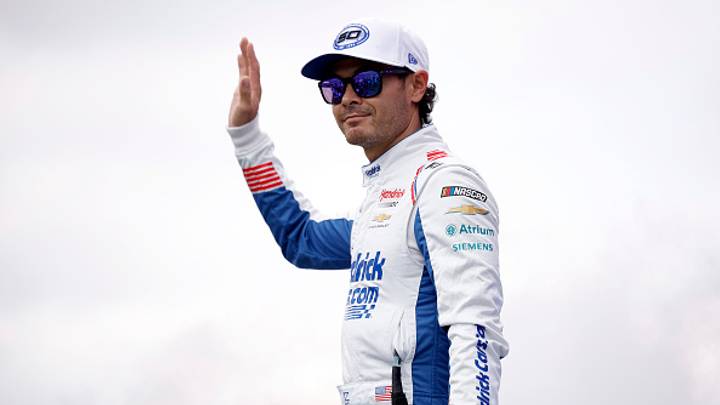
When NASCAR finally announced the end of the "win and in", knockout-style playoff format, concluding a 12-year run in the Cup Series, by bringing back the "Chase" setup that was used from 2004 to 2013, the majority of NASCAR fans celebrated.
Every point was supposed to matter again, and no longer would a well-timed victory mean more than season-long consistency or even a group of victories, simply because of when that win happened.
Of course, it didn't take long to figure out that some of the same issues NASCAR fans had with "win and in" still exist. For one, the point values for all 16 playoff drivers to begin the postseason are now entirely predetermined, meaning that regular season success might actually mean less now than it did during "win and in". Whether you win the regular season championship by one point or 500 points, your lead to start the playoffs is 25. Period.
Just ask Denny Hamlin, who lost more than 3,000 combined points to the other 15 postseason drivers to begin the postseason. Only one driver ended the regular season within 130 points of Hamlin, but all 15 started the postseason within 100 of him.
Kyle Larson finished the regular season 303 points behind Hamlin, gained 248 points on him due to the reset, and now finds himself with a 26-point lead, amid a three-race streak of top two finishes that has included two victories, his first two wins since May 2025.
Larson led the series in total points scored in 2025, but his 2025 championship still generated enough criticism that it proved to be the final nail in coffin for "win and in". An entire 36-race season was basically reduced to a two-lap overtime that followed a questionable caution flag, setting up pit strategy decisions that would not have otherwise happened in a title decider that Hamlin had dominated.
But let's not lose sight of the fact that Larson won the 2025 championship under a "win and in" format without actually winning a playoff race. Maybe he wasn't at his best, but he was better than anybody else when he needed to be.
He's been both in 2026.
Kyle Larson's run proves one thing hasn't changed since 2025
One thing has not fundamentally changed throughout NASCAR history, regardless of what championship format or points format has been in place: every single driver plays by the same rules, and everybody is aware of what those rules are.
The 10-race postseason means significantly more than the 26-race regular season. Larson is performing at his best, and despite having scored 222 fewer total points than Hamlin this year, his performance over the first four playoff races has been enough to put him in the catbird seat to win another title.
Sure, there are still six races left; the championship battle is far from over. But he's doing what he needs to do, when he needs to do it.
The concept is absolutely no different from what it was in 2025, even though the formats, on paper, look drastically different, and one was so much more criticized than the other one is.
Who "deserves" to be crowned champion has never mattered. It shouldn't matter. What matters is who earns it. Larson earned it in 2025, under the rules that were in place for everybody at the time.
And regardless of who wins it in 2026, whether that's Larson or Hamlin or somebody else, they will have earned it as well, even if they don't lead the series in season-long points.
The fifth race of the 2026 NASCAR Cup Series playoffs is the South Point 400, which is set to be shown live on USA Network from Las Vegas Motor Speedway starting at 5:30 p.m. ET this Sunday, October 4. Don't miss any of the action as the postseason approaches its halfway mark!
 Add us as a preferred source on Google