

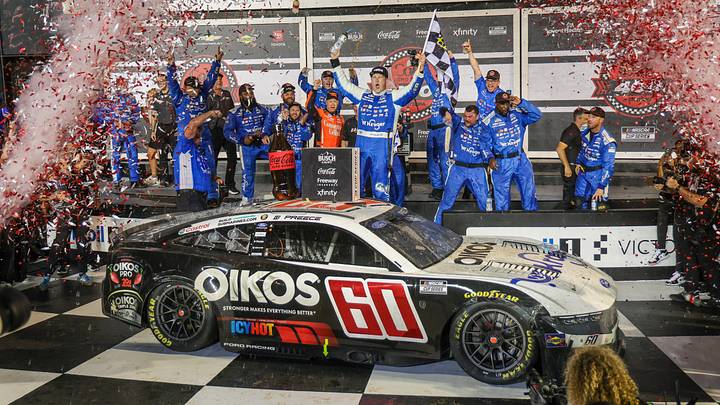
Saturday night's Coke Zero Sugar 400 at Daytona International Speedway was the final race to make the 2026 Chase for the Cup, and it provided the most hilarious outcome possible.
Ryan Preece, who had zero top five finishes this season entering the event, won his way into the NASCAR Cup Series postseason field over Shane van Gisbergen.
It came via a hectic overtime dash that resulted in multiple accidents on the backstretch on the final lap, first when Zane Smith threw an ill-fated block and then when Ricky Stenhouse Jr. clipped Ryan Blaney. Preece was scored half a car length ahead of Daniel Suarez when the caution was thrown.
Welcome back, demolition derby superspeedway finishes. This is what all the fans asked for.
NASCAR fixed its gridlock Next Gen superspeedway package, but recreated an entirely new (old) problem in the process
All the anticipation entering Saturday night pertained to how the Cup Series' new superspeedway package would run, a change made to combat the two-by-two gridlock that has become problematic at Daytona and Talladega Superspeedway with the Next Gen car. It solved that issue, but it came at a price.
With more maneuverability, there are also more opportunities to cause wrecks. And that's exactly what the end of this race gave us, in addition to the final lap of the opening stage, when van Gisbergen gave Kyle Larson a hard shove into Chris Buescher.
It felt like we were right back in the Gen 6 era. And if you lived through the Gen 6 era, fans did not like superspeedway racing during the Gen 6 era.
The 2018 and 2021 Daytona 500s may have together combined to tank at least 90 percent of the value of winning the sport's most prestigious race. The 2019 Coke Zero 400 was one of the biggest LOL-worthy "it's so sad it's funny" races in NASCAR history. The 2017 fall Talladega race had about three undamaged cars running at the finish.
It was during this era, especially after the implementation of stage racing, that these tracks could no longer be taken seriously as the true test of skill they once were. Drivers would ride around for most of a run, decide to start making moves with a few laps to go in the stage or race, and immediately wreck. And that was exactly what we saw on Saturday night.
The fuel-saving problem still exists. The closing rates are still much too fast and the pack is still too condensed together. The racing remains a far cry from the glory days of Daytona prior to its 2011 repave, or what we currently see at EchoPark Speedway in Atlanta, where handling is paramount and it's actually possible to tell which cars and drivers are better than others.
The finish was entertaining if anything, and it was nice to see the cars able to move around. But the random-number-generated result isn't what NASCAR should be aiming for.
 Add us as a preferred source on Google