

One of the biggest complaints about the old "win and in", knockout-style NASCAR Cup Series playoff format, which was instituted in 2014 and lasted for 12 years, was that it completely removed the meaning of the regular season.
All that supposedly mattered was getting hot (or, on the flip side, going cold) at the right (or wrong) time, while the "best driver" was not necessarily rewarded over 36 races.
Historically speaking, those were hard points to argue against, given how often the format produced some unlikely champions whose seasons were nowhere near as strong, from top to bottom, as the seasons of some of the drivers who came up shy of the title.
Many fans urged NASCAR to get rid of the playoffs entirely and go back to a full-season championship. NASCAR didn't go that far, but they did go back to the "Chase" format that was used from 2004 to 2013, with just one points reset following the 26-race regular season.
While NASCAR still doesn't use a full-season format, the regular season was said to finally matter again. Every point was once again going to mean something, and no longer could a well-timed win be more valuable than a collection of wins, simply because of when that win happened.
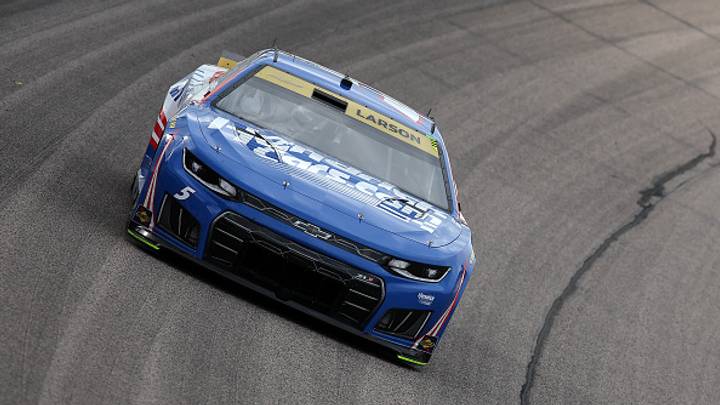
And Kyle Larson has already shredded that narrative.
Larson finished the regular season championship in seventh place, 303 points behind Denny Hamlin. For reference, the maximum point total for a single race is 76. You could have removed all four of Hamlin's regular season wins from his tally, and he'd have still been ahead of Larson.
In terms of total points scored, Larson still trails Hamlin by 222 over the season's first 30 races. For him to make that up over the final six races of the season, he would need pretty much everything to go his way, while Hamlin would have to have just about everything go wrong.
Instead, Larson owns a 26-point lead over Hamlin. Why? Because he's gotten hot at the right time.
After a winless regular season, which saw his win drought extend to 50 races, the longest ever for a reigning champion, Larson has reeled off four straight top five finishes to begin the postseason.
And after recording just one runner-up finish during the regular season, he is currently riding a streak of three straight top two results, including his first two wins of the year at World Wide Technology Raceway at Gateway and Kansas Speedway.
Yes, every point matters. Every point matters now, that is. In September. In the playoffs.
No, every point did not matter in the regular season.
Sure, NASCAR tried to reward regular season success with bonus points to begin the postseason, but the margins between positions were extremely small. Hamlin, as the regular season champion, lost more than 3,000 combined points over the other 15 championship contenders, with 248 lost to Larson.
All 15 of those drivers began the playoffs within 100 points of Hamlin, after just one (Ryan Blaney) finished the regular season within 130.
Larson has proven to the NASCAR world that the regular season means no more now than it did during "win and in".
In fact, it might even mean less, because the only real difference is that you don't have a 27th-place driver winning his way into the playoffs with a fluke regular season victory at Talladega or Daytona.
But it's not as if those drivers were keeping true championship threats out to begin with, since there are never truly 16 title contenders, so all things considered, the removal of "win and in" really didn't do all that much.
Can Larson keep his hot streak going at Las Vegas Motor Speedway, where he has won three times since 2021? The South Point 400 is scheduled to take place this Sunday, October 4, with USA Network set to provide live coverage starting at 5:30 p.m. ET.
 Add us as a preferred source on Google