

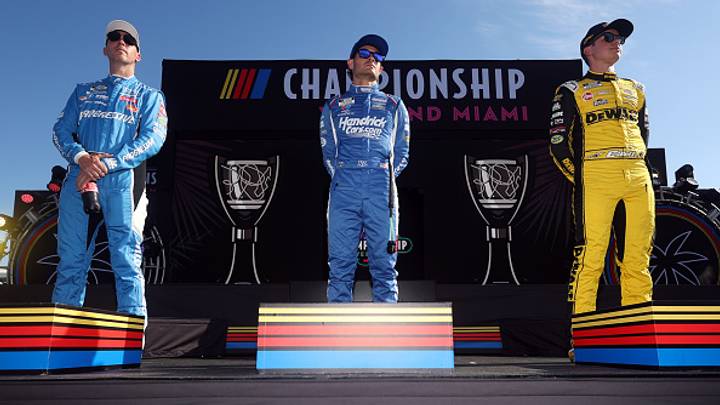
After 12 seasons of the much-maligned "win and in", knockout-style Championship 4 postseason format, NASCAR made the long-awaited decision to return to an iteration of the "Chase" that was used to begin the playoff era from 2004 to 2013.
Some of the key knocks against the Championship 4 format were that the regular season didn't matter enough, getting hot at the right time was more important than a sustained hot streak, an entire 36-race season could come down to an ill-timed (or, in some cases, a phantom) caution, and the championship battle was generally artificial and manufactured, just to ensure it came down to the wire.
The decision to go back to the Chase format was praised by pretty much everybody in the sport, from the drivers, to the teams, to the fans, to the media, etc. And with how many fans claimed they'd start watching again now that the "fake" championship format was gone, NASCAR was due for a popularity boom not seen in decades.
Then reality struck.
And it didn't take long for the rose-colored glasses to come off.
Two of the 10 postseason races saw viewership increase, year-over-year. Two. And they were the first two. The final eight all dropped significantly.
Given how much viewership had declined over the years leading up to 2026, the fact that eight of the 10 races saw further decline is alarming. It really should not have been all that difficult to at least stabilize the ship, at least for as much as we heard about how the return to the Chase was supposedly going to bring back the fans that got sick and tired of the "fake" championship battles.
The postseason opener at Darlington Raceway was up 5.4%. The second race at World Wide Technology Raceway at Gateway was up 7.2%.
Then things went south. Big-time.
The Bristol Motor Speedway night race dropped by 5.7%, and while the convenient "college football" excuse was repeated time and time again, we will remind you that the 2026 season isn't the first-ever season in which college football has existed. While that may factor in to an overall decrease from one individual race to the next, it is not a relevant year-over-year factor whatsoever.
The same goes for NFL on Sundays, which is when every other race on the postseason calendar was contested. "But football was on!" does not explain an annual decline.
Kansas Speedway saw an 8.5% decrease in viewership. Las Vegas Motor Speedway dropped by 8.2%. Charlotte Motor Speedway dropped by 17.8%, and that's despite the fact that the race was contested on the oval for the first time since 2017, after fans had been begging to ditch the Roval. Then it was finally ditched, and viewership tanked. Imagine that.
Phoenix Raceway saw a 53.4% decrease, although it did host the 2025 championship decider. Phoenix took Las Vegas' old schedule slot, so it was really down "just" 24.8%, although that should tell you all you need to know about the fact that fans, despite the gripes, were significantly more likely to tune in to the Championship 4 they all claimed to despise.
Martinsville Speedway saw a 13.6% decrease, and finally, the Homestead-Miami Speedway season finale saw a 10.9% drop-off from the 2025 Phoenix finale.
Is it time to bring back to the Championship 4?
Of course, I'm half-joking here. But maybe the manufactured drama, the "Game 7 moment", is what fans really wanted all along, even if fans were afraid to admit it.
Maybe the "bring back the Chase" campaign was really just for social media likes and engagement, because anybody and everybody who ever dared say anything nice about the previous format was crucified. Maybe nobody was brave enough to come out and say that they actually enjoyed the elimination format. Who knows?
For the record, I think the Chase is a better way of crowning a champion than relying on three consecutive volatile three-race rounds and a winner-take-all championship finale that guarantees four drivers are still eligible. I think that's a fairly agreeable point that a lot of folks genuinely share.
But for as much as fans liked to knock it as "fake", more people tuned in to the format that actually guaranteed a battle that was exciting and would go down to the wire, rather than the format that opened up the possibility for a championship runaway.
Then we got the championship runaway, and fans unsurprisingly tuned out.
And I don't think it would have been better under a full-season points format, either. The championship would have been completely locked up even before the season finale, and it would not have been a close battle at any point during the season's final 10 races, so not much really would have changed.
Don't place full blame on NASCAR's postseason struggles
Having said that, I don't think we can fully blame the playoff format change for the drop-off, especially since, despite the clear decline from the Championship 4 era, the majority of fans do still seem relatively pleased with how things turned out, even if a Kyle Larson championship was a foregone conclusion well before the green flag flew at Homestead.
And I think it would have been completely naive to assume that, just because the format changed, fans were going to return to the sport in droves. That was always a pipe dream.
First and foremost, the Next Gen car has probably been criticized more than any playoff format has ever been, and NASCAR has made clear that they aren't planning any sweeping changes heading into 2027, even though the car continues to fail to deliver a strong (or even, quite literally, a non-weak) on-track product at pretty much every type of track on the schedule.
So regardless of what postseason format, if any, is used, don't be surprised if ratings continue to decrease into year number six of the Next Gen car. Can somebody remind me of the definition of insanity? Why would frustrated fans even want to bother?
Secondly, look at IndyCar's ratings. From 2006 to 2022, every single IndyCar championship was decided in the season finale. And yes, that would have been true even without the double-points season finales that were used from 2014 to 2019.
Now that hasn't been the case since 2024, yet the series still set several viewership records in 2025 and completely smashed them in 2026. So a down-to-the-wire championship battle is far from the only factor that matters to race fans (even if they do still sometimes complain about the lack of one).
And finally, NASCAR currently lacks the mainstream, household names to actually make a serious viewership impact beyond the core fanbase, which is unmistakably continuing to decline. That's just the reality of it.
Where I would disagree with the party line is that drivers don't have personalities. I think fans have a knack for looking at the past through nostalgia-colored glasses to the point where we don't appreciate the personalities the sport does currently have, and we mistake the lack of household names for "drivers are just corporate PR spokesmen", when that's clearly not the case.
Still, the end result is the same: fans aren't tuning in. And therein lies the problem.
Even with NASCAR leaning into the larger-than-life personalities of figures such as Carson Hocevar and Cleetus McFarland, it's not making a difference when it comes to viewership. It might make things more interesting for the viewers already watching, but is the audience actually growing?
No.
Would an adjusted playoff format really change that?
I think 2026 proved that answer is also no. And I think that, after viewership continued to drop significantly despite fans getting the number one change they had been beginning for for years, we can finally start to focus on what might actually bring about change.
The only real question is whether any single change, whether it's the Next Gen car, the postseason format, or something else entirely, is actually capable of reversing NASCAR's decline. Perhaps after 2026, we're naive to think that would be the case as well.
 Add us as a preferred source on Google