

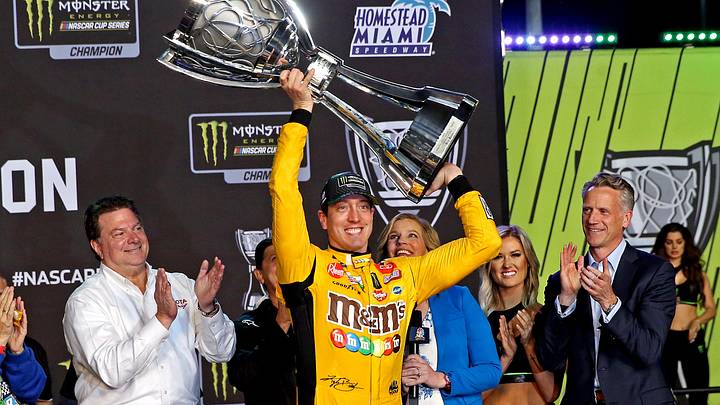
On Thursday, the NASCAR community unexpectedly lost one of its greatest and most iconic drivers of all-time in Kyle Busch. He passed away suddenly after being hospitalized with what was described only as a severe illness, later revealed to be pneumonia leading to sepsis.
It's days like this one that remind us of how precious and how fragile life can be – and, as NASCAR fans, how fortunate we have been for the past 25 years. Ever since February 18, 2001.
The day we lost Dale Earnhardt.
Until now, an entire generation had never known what it was like to live through the death of an active Cup Series driver. That, combined with the pure shock value and sheer magnitude of who Busch was, makes May 21, 2026 NASCAR's darkest day in a quarter of a century.
Unthinkable Kyle Busch news highlights the constant fragility of life in a sport that's known this feeling all too well
It's a testament to modern safety and medicine that NASCAR had not seen such a loss since Earnhardt, and still hasn't due to an on-track incident. But it felt for years like we had been testing fate.
Austin Dillon's harrowing crash in the 2015 Coke Zero 400 at Daytona International Speedway briefly brought the racing world to a hush, only for the driver to emerge unscathed from his demolished vehicle moments later.
The concern for Ryan Newman after the 2020 Daytona 500 was prolonged for well over an hour, yet he too survived with only some bumps and bruises.
Luck finally ran out last December, when NASCAR was rocked by the tragic news of 19-race Cup Series winner Greg Biffle's plane accident. Yet the loss of Busch hits at substantially more seismic proportions, due to the fact that race fans were still actively following his livelihood every single week.
This was a 41-year-old who had no plans to retire anytime soon. He won a Craftsman Truck Series race at Dover Motor Speedway just last weekend, and now he's gone the next. It's unthinkable. It's unfathomable. It feels like a bad dream that we'll all wake up from, and then life will be back to normal again.
Sure, that has to be it. Just a bad dream. When the green flag drops on the Coca-Cola 600 at Charlotte Motor Speedway on Sunday, Busch will be driving the No. 8 Chevrolet for Richard Childress Racing, just as he has every week for the past four seasons.
He'll look to capitalize on the momentum he'd been quietly building in recent runs, and we'll all speculate whether or not he ends up moving to Spire Motorsports, for whom he runs his Truck Series races, in 2027.
But he won't.
He won't be driving anywhere next season, and he won't be driving on Sunday. He won't be breaking his three-year Cup Series winless streak. He won't be at the track to maintain a presence within the sport following his retirement.
Most heartbreakingly of all, he won't get to witness his 11-year-old son Brexton rise through the ranks and become a potential star at the highest level, something he'll now have to do in a more impossible situation than any driver since Dale Earnhardt Jr.
It's going to take a while for the horrible reality of Busch's situation to set in. And yet it's something NASCAR used to have to confront all the time. The way the mood feels this weekend is the same way it felt in February 2001.
The way it felt not once, but twice during the 1993 season, when two of the previous year's top three points finishers in Alan Kulwicki and Davey Allison were killed in separate plane and helicopter crashes.
The way it felt when Tim Richmond succumbed to his battle with AIDS in 1989.
But that's not supposed to happen anymore. Every time in the past 25 years that we've had to brace ourselves for bad news regarding an active competitor, the worst-case scenario has been avoided. And we've assumed it always will be.
Until now. Until May 21, 2026, a day that came completely without warning. And that's what makes it so difficult to make peace with.
We found out in the morning that Busch was in the hospital and would miss the Coke 600, but nothing more. No mention of critical condition. No indication at all that this was even remotely life-threatening. We knew he'd been under the weather dating back to two weeks ago at Watkins Glen International, and initially it seemed no different than Alex Bowman's vertigo situation earlier this year. He'll miss maybe a few races, but he'll be fine.
Then, six hours later, it was all over.
Busch's death was a freak occurrence. It wasn't an accident on the track, or one traveling to or from the track. But nevertheless, it was something that could have happened to anybody, anywhere, at any time. For NASCAR fans under the age of 30 who had never experienced such a loss before, that's a scary thought.
For a quarter of a century, we have been spoiled. A day like this one was always going to come again. We just didn't know when, and we didn't know how. And we didn't know it was going to be Kyle Busch.
He was hated by some, but loved by many more. He gave us memories and snarky one-liners we'll treasure forever. And as NASCAR mourns Busch's passing and honors everything he meant to this sport, he leaves us with one final chilling reminder.
You never know when the last one is.
 Add us as a preferred source on Google