

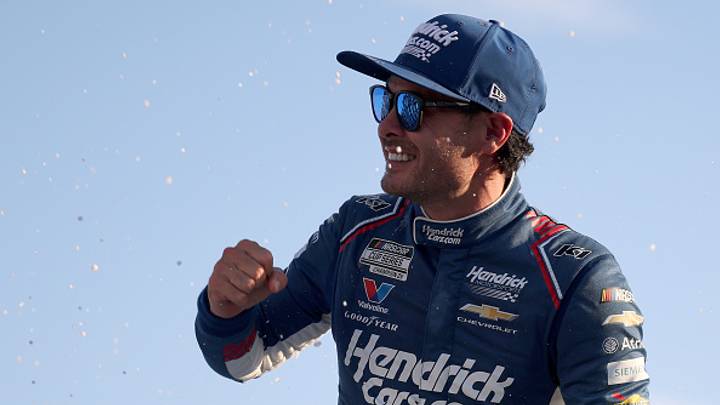
Kyle Larson finally ended the longest win drought in NASCAR Cup Series history for a reigning champion on Sunday in an 18-caution wreck-fest at World Wide Technology Raceway at Gateway, with his trip to victory lane becoming his first since he won at Kansas Speedway in May 2025.
The victory came in the second race of the 10-race "Chase" postseason, and all of a sudden, the driver who had basically become an afterthought this year due to the overwhelming struggles of Hendrick Motorsports and Chevrolet as a whole is second in the standings, just nine points behind regular season champion Denny Hamlin.
Funny enough, the win sent the exact same message that a win under NASCAR's old (and much-maligned) playoff format would have sent: there's no such thing as "getting hot at the right time" or "getting cold at the wrong time" when that "time" is June or July.
What matters most was and continues to be the postseason, and that is entirely by design.
With that in mind, let's flash back to 2025 for a second, because for as much criticism as Larson's championship still gets, a lot of that is perhaps misdirected.
The 2025 title was Hamlin's to lose before a somewhat controversial caution flag set up unexpected pit stops and overtime in the championship race at Phoenix Raceway, resulting in Larson's second title.
We've all heard the argument that Larson actually led the series in full-season points, so he would have been the "rightful champion" either way. Fair enough.
In that regard, it is sort of ironic that the full-season points champion winning the playoff championship is what ultimately sunk the knife into the "win and in" playoff format, given how many other, shall we say, interesting champions the old format produced during its first 11 years of existence.
Even more ironic? The fact that Larson didn't even need to win a single playoff race in a format that rewarded race wins to a fault in order to win the championship.
The first 24 races of Larson's 51-race win drought came to wrap up the 2025 season. Despite going 0-for-10 in a "win and in" postseason, he still played by the same rules and beat the other 15 playoff drivers, advancing to the Championship 4 and winning the championship.
Did he win because of the format, or in spite of the format? At the end of the day, who really cares? The bottom line is that Larson and the No. 5 team know how to be not necessarily at their own best when it matters most, but better than everybody else when it matters most, and they know how to do that regardless of what the format looks like.
That still matters more than any other individual factor. It didn't change just because he was seeded in the middle of NASCAR's 16-driver playoff field following a lackluster regular season, it didn't change because he finished the regular season 303 points behind Hamlin, and it didn't change because NASCAR effectively went from a four-round postseason to a single-round postseason.
Of course, it doesn't guarantee he'll win the 2026 championship; there are eight races left on the schedule. But it proves that the reports of his downfall were indeed greatly exaggerated, and that even under the new playoff format that fans supposedly love so much, the regular season still only matters so much, perhaps even less so than it did before.
Bristol Motor Speedway, where Larson won in 2021, 2024, and 2025, is scheduled to host the Bass Pro Shops Night Race this Saturday, September 19, with live coverage set to be provided by USA Network starting at 7:30 p.m. ET.
 Add us as a preferred source on Google