

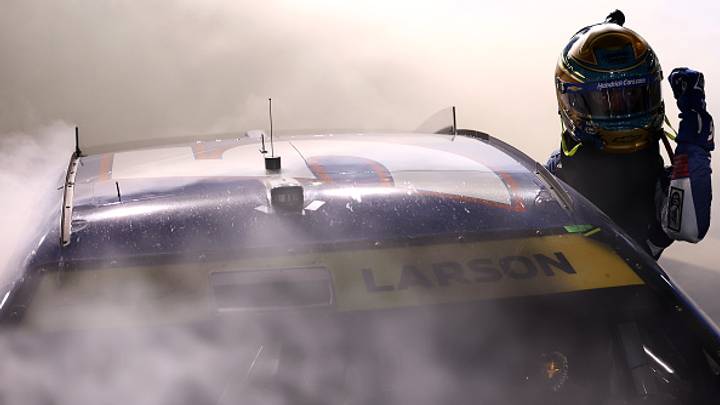
After a winless regular season which saw his NASCAR Cup Series championship odds dip to +3500 at one point, reigning champion Kyle Larson took the points lead just three races into the 10-race Chase, and he never looked back.
By the time the season finale at Homestead-Miami Speedway rolled around, Larson clinching the title was a mere formality. He was able to mathematically clinch it by the end of the race's first stage, at which point he admitted he started "driving like an idiot" before claiming his third Bill France Cup since 2021.
Larson finished the regular season 303 points behind regular season champion Denny Hamlin, and he was seventh in the standings. In fact, in full-season points, he still finished 192 points behind Hamlin. He would have been eliminated with two races left, and Hamlin would have clinched before the finale.
Alas, NASCAR does not use a full-season points format, and the post-regular season points reset was one of the big storylines both of the regular season and of the postseason, given just how much it played a role in deciding the outcome of the season.
For reference, Larson gained 248 points on Hamlin because of the reset, starting the playoffs 55 points behind rather than 303. Hamlin's full-season lead over second place actually extended from 89 to 102 over the Chase's 10 races, even though he ended up officially finishing 56 points behind Larson – and in third, not second.
But throughout the regular season, we kept hearing that nobody outside of the top six in the regular season standings would realistically have a chance to contend for a championship. Every week, we kept hearing about the importance of being in that top six, within 50 points of the top spot, after the reset.
Why? Seriously, why?
No reason, literally. It was about as arbitrary of a number as you could find, yet that's what the experts kept inexplicably pointing to.
First of all, NASCAR boosted the value of wins this year to 55 points, rather than 40, to make up for the removal of "win and in". They are now worth 20 more points than second place finishes. And yes, stage racing still exists too, putting 20 more points up for grabs in each race.
Why in the world would a driver need to start the postseason within 50 points of the leader to have a chance to get to first place over the course of 10 weeks?
Second of all, beyond the top three, only five points separate each position in the post-regular season reset points table. Are you really telling me that a guy 50 points back has a shot, but a guy 55 or 60 points back doesn't?
You can literally make up one full position by finishing sixth in the first stage of the opening playoff race alone.
We also saw multiple times throughout the season how little time it took to erase what once might have been considered a sizable gap. That was no different during the playoffs.
And it wasn't just Larson, either. Just three races after trailing Larson by 123 points, Chase Briscoe was actually briefly the points leader in "points as they run" during the race at Phoenix Raceway.
Larson could have started the playoffs 16th and still won the championship. In fact, he would have won it by four points over Christopher Bell had he entered with zero bonus points, 100 points out of the lead.
And quite frankly, starting 16th might have actually been fitting for how his regular season went, given just how "invisible", per se, he was during much of those 26 races. But he still outscored Hamlin by 111 points (and Bell by 54) during that crucial 10-race stretch.
Here's some food for thought. One driver finished the regular season withing 130 points of Denny Hamlin. Just one (Ryan Blaney, -89). How many started the postseason within 100 points of him? All 15 of his rivals.
The Chase format still awards regular season success; sure. But because of the predetermined narrow margins between each position, it doesn't necessarily penalize the lack thereof, or at least not nearly to the extent that many initially thought it would.
Now, obviously nobody in their right mind, with all due respect, was picking Ryan Preece, who actually started 16th, to win the championship. We get that, and we've said all season that 16 Chase drivers is probably too many.
But the whole "top six" myth was quite literally dispelled within 13 days of the playoffs starting, and who better to dispel it than the best stock car driver of this generation, who just so happened to start seventh?
Regardless of how many drivers get into the postseason, every single one of them has a shot to win the title, regardless of where they start. And the post-regular season points reset values effectively make sure of that. Even after NASCAR did away with the "win and in", knockout-style Championship 4 elimination format, it's still all about performing at the highest level when it matters most.
 Add us as a preferred source on Google